The Netherlands is aging, but the societal role of older people is changing at least as significantly as their numbers. A growing group continues to work after retirement age and combines this with hobbies, family visits, and holidays. As a result, for recreation businesses, seniors are simultaneously an important guest group and a potential reinforcement of the team.
More older people remain socially active
Demographic developments increase the importance of this group. According to the CBS forecast, the Netherlands had approximately 3,8 million people aged 65 and over at the end of 2025. From 2040 onwards, this number is expected to reach 4,8 million, about a quarter of the population. Moreover, since 2025, there have been more people aged 65 and over than residents under the age of twenty. Entrepreneurs will therefore have to deal with a substantial target group that can no longer be approached as a single traditional senior segment.
Labour participation is also changing. In 2015, approximately 10 percent of 65- to 75-year-olds had paid work; in 2025, this was nearly 21 percent. In the second quarter of 2026, 9,5 percent of all state pension recipients were employed, compared to 7,2 percent in 2014. Work after retirement is on the rise, and this offers various new opportunities in the tight labour market.
Continuing to work is part of an active lifestyle
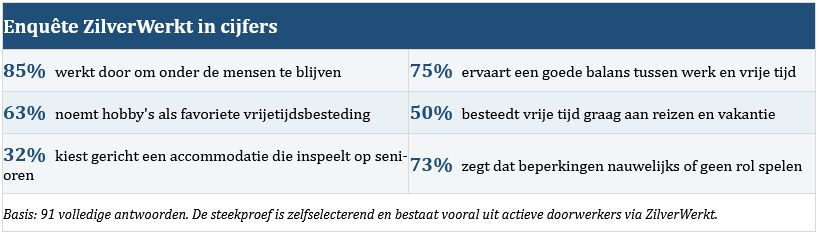
ZilverWerkt connects state pension recipients with organizations and regularly conducts surveys within its own database of registered and working experienced professionals, showing what this choice means for an active group of older people. In August 2026, it conducted a survey; 91 respondents participated; 95 percent of them were working through ZilverWerkt at that time. The results are therefore not representative of all older people. They primarily provide insight into an emerging segment of relatively healthy, active people who consciously choose to continue working.
- For 85 percent, 'staying among people' is the most important reason to continue working.
- 'Participating in society' is mentioned by 51 percent
- and stay fit by 47 percent.
- Extra income plays a role for 44 percent, but only 10 percent say they really need the income.
For this group, therefore, work primarily has a social and societal function.
Three-quarters experience a good balance between work and leisure. More than half are not considering quitting for the time being, and 38 percent would drop out if the work were no longer enjoyable. Physical capacity determines the limit more often than mental capacity: 53 percent cite physical decline as a possible point to stop, compared to 19 percent for mental decline. At the same time, nearly three-quarters say that physical or mental limitations currently play little to no role.
Leisure time remains broad and social
Continuing to work does not displace free time. Hobbies such as sports and culture are cited by 63 percent as favorite pastimes. Family and grandchildren follow with 51 percent, travel and holidays with 50 percent, and relaxation with 47 percent. Volunteering lags clearly behind at 16 percent. For these respondents, social contacts and a sense of purpose apparently come together more in paid work and leisure activities than in volunteering.
There is no single, clear profile of senior vacation behavior either. For 52 percent, preferences have remained largely the same. Of those who do experience a change, 21 percent consciously choose rest and comfort; 14 percent opt for more meaningful experiences; and 13 percent choose more active and adventurous vacations. Travel style and life stage thus reveal more than just age.
Almost half believe that most holiday accommodations already cater well to seniors. Another 32 percent specifically choose the accommodations that do this best, while 20 percent see room for improvement. Senior-friendliness is therefore a selection criterion, but an explicit label such as "senior product" is by no means always necessary. Many guests do not identify with that label. Moreover, they regularly travel with children and grandchildren, making accessibility and comfort a multi-generational issue as well.
Hospitality begins before anything goes wrong
According to Chantall Olthoff of ZilverWerkt, the greatest gains are often made at the beginning of the guest journey. A clear welcome and calmly explaining how the accommodation, grounds, or a digital system works prevents questions and corrective work later in the stay.
Five extra minutes upon arrival are the cheapest minutes of the entire stay.
Chantall Olthoff, ZilverWerkt
This calls for performance indicators other than just handling time, occupancy rate, and revenue per hour worked. The proportion of returning guests in the shoulder seasons, for example, can reveal whether the hospitality is truly working. Otherwise, time saved during the reception often results in phone calls, complaints, misunderstandings, and extra work.
Digitalization needs a visible way out.
Online check-in, QR menus, reservation apps, digital keys, and fault portals can speed up operations. However, for some older guests, they shift the work onto the user. Those who get stuck will still approach a staff member. Those who do not wish to ask may order less or decide not to return. Such silent attrition rarely appears in complaint records.
Those who can't get the QR code scanned usually don't complain. They don't order a drink and don't come back.
Chantall Olthoff, ZilverWerkt
The practical solution is to keep a recognizable analog route available alongside every digital system. Think of a paper menu visibly on display, a counter staffed at fixed times, and a phone number where someone answers. This helps not only the elderly but also guests with a dead phone, a technical issue, or limited digital skills.
Keep one analog route open for each digital system and make it visible.
Chantall Olthoff, ZilverWerkt
Experienced staff strengthen the pre-season
Olthoff also points out an occupancy paradox. Relatively many older guests stay precisely during the shoulder seasons, while recreation businesses often work with a smaller and less experienced team during this period. By deploying experienced staff specifically during these periods, staffing levels align better with the need for peace, familiarity, and clear explanations.
In this approach, age diversity is a measure of hospitality. Older guests sometimes naturally seek out employees of their own generation. These employees are more likely to recognize when someone is struggling with hearing, jargon, or a digital process, without explicitly making a problem of it. Moreover, experience does not automatically lead to slower work. An employee who knows which steps are necessary prevents duplication of work and dares to point out when a procedure is not functioning properly.
Age diversity in your team is a hospitality measure, not a personnel measure.
Chantall Olthoff, ZilverWerkt
However, this requires authorization. An employee who does not know whether a five-minute conversation is permitted will easily prioritize haste. An entrepreneur can create space with a simple message: paying attention to the guest counts as work, not as a waste of time.
Improving comfort without being patronizing
Part of the improvements lie in the physical environment. Less background music and better acoustics make conversations at the table more pleasant. Legible fonts, sufficient contrast, good lighting, resting points along longer walking routes, and the removal of unnecessary obstacles help a large group of guests without disturbing others.
The line is drawn at patronizing. Hospitality means offering help and letting the guest choose. Taking over luggage without being asked, speaking excessively slowly, or making decisions for someone can actually provoke resistance. The difference between a vital 65-year-old and a vulnerable 85-year-old can be significant, but age alone does not predict need.
Hospitality towards the elderly means offering choice: asking instead of assuming, offering instead of taking over, and letting the guest decide whether they want help.
Chantall Olthoff, ZilverWerkt
For the leisure sector, the opportunity therefore extends beyond a separate senior package. A relaxed welcome, a choice between digital and personal service, a comfortable environment, and a diverse team improve the experience for many guests. Moreover, the active senior demonstrates that the same person can be an employee one weekend and a guest the next. Those who take both roles seriously connect better with a rapidly growing group.
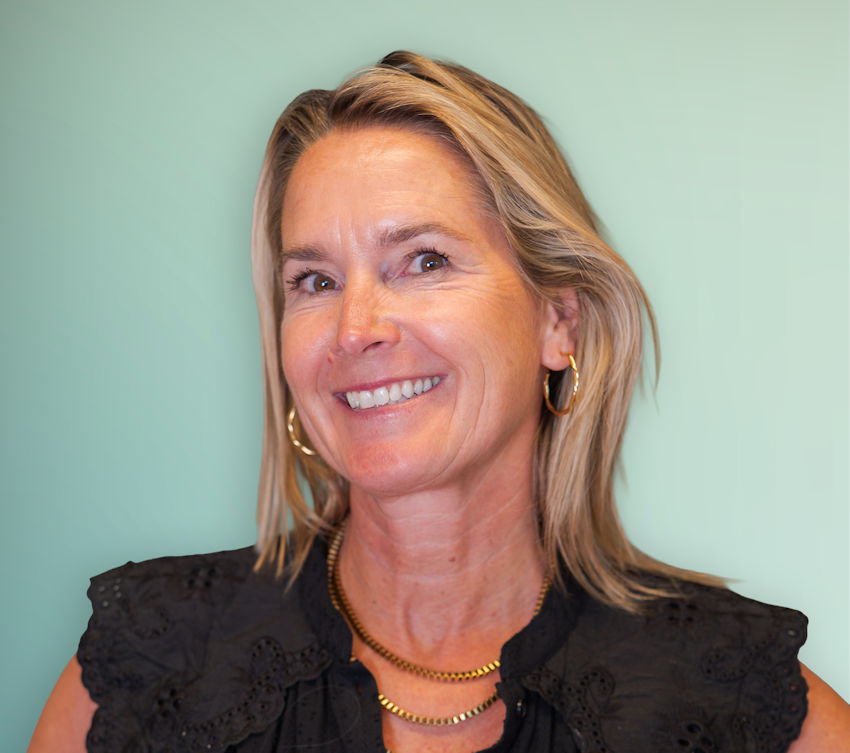
With thanks to (author of this article) : Chantall Olthoff, Managing Director ZilverWerkt
More information: www.zilverwerkt.nl