During the Sustainability Conference of the Camping Industry on 2 October, there was no shortage of good intentions. In practice, it turns out to be more difficult, but the sector is determined to make progress. One observation was that a large proportion of campers still attach relatively little value to a sustainable stay (especially if it costs more). This largely places the responsibility with entrepreneurs who play a pioneering role.
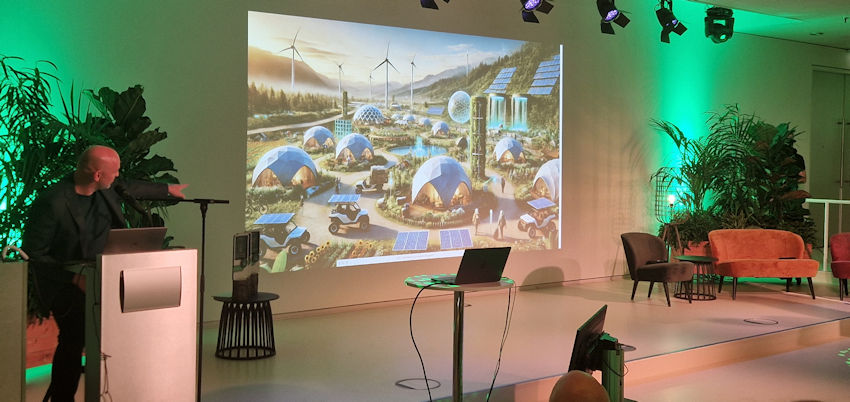
“It would be great if everyone contributed to a more sustainable world.”, was the appeal of philosopher Ruud Veltenaar in the first presentation. In later lectures, this was regularly referred to, but mainly with the caveats that in the recreation sector it is mainly entrepreneurs (including campsites and suppliers of camping equipment) who can inform consumers and help them on their way; especially by setting a good example themselves.
Sustainability is hardly a decision factor yet
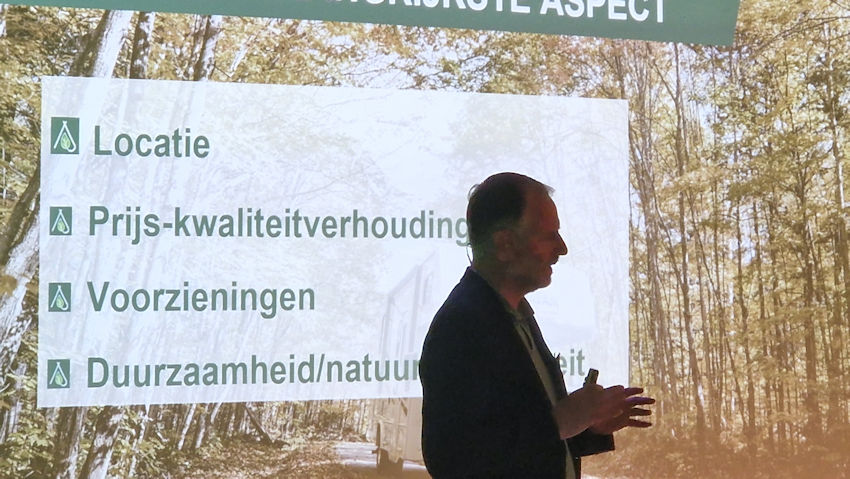
Research by the ANWB (conducted by Q&A) shows that sustainability arguments are decisive or very decisive for 22% of campers in their holiday choices. When choosing a camping spot, the criterion 'sustainability and nature inclusiveness of the destination' has doubled (from 4% to 8%) compared to 2023. But this is still only a minor issue in holiday planning. The destination / location remains the most important decision factor for a camping spot with 45% (last year 40%).
Mirjam van Riel, from Libema Holiday Parks, was also down-to-earth about the added value of the sustainability factor in the marketing of the parks: “When booking at our parks, sustainability is not actually selected. For example, our cottages do have energy labels, but nobody actually asks about them.”
Paul Makken of the ANWB also spoke sceptically: “The need to travel is strongly rooted in people. The consumer will not save the world. But fortunately there is another party that takes the lead. That is the entrepreneurs. I see many beautiful things happening at companies. Incidentally, the entrepreneurs could do a bit more to explain their green initiatives to their guests and in this way take them along to a more sustainable living environment. This should be done subtly, because 'sustainability' is still experienced as 'not nice' by a large group of people.”
Van Riel mentioned another example of a way in which a company can make its guests more sustainable: “Incentives work very well. If the consumer is rewarded for sustainable behavior, then we suddenly see a movement in the right direction. That can be a discount, but also an extra to make the stay more pleasant. Sustainability often also means cost savings and ultimately everyone benefits from that.”
Camping is essentially a green activity
From the camping sector it became clear that many companies see the added value of sustainable business operations. Many campsites are located in nature reserves and this environment is a core value of the camping stay. By looking at sustainability in this way, the importance is suddenly drawn much broader; who wouldn't want to stay in beautiful surroundings.
Not only from the consumer side are there hurdles to overcome, technology is also in full swing to develop alternatives for polluting options. In this, the focus is mainly on the emission of diesel by (mainly large) campers. The fuel transition study by Ecorys, presented by director Stan Stolwerk (NKC), shows that at the moment 92% of campers still run on diesel. You can look at that pessimistically, but there is still a world to be won in that area. Alternatives are being developed, such as electric driving or LPG gas, but these are not yet very practical or very expensive for the heavier camper models. The sector is also highly dependent on innovations in the automotive industry.
In the subsequent panel discussion it became clear that the camping and water recreation sector faces similar challenges. Collaboration and knowledge sharing within the sectors are essential to jointly develop sustainable solutions. What can we learn from each other? The water sports sector is already leading in some areas and offers valuable lessons.
Green pioneers
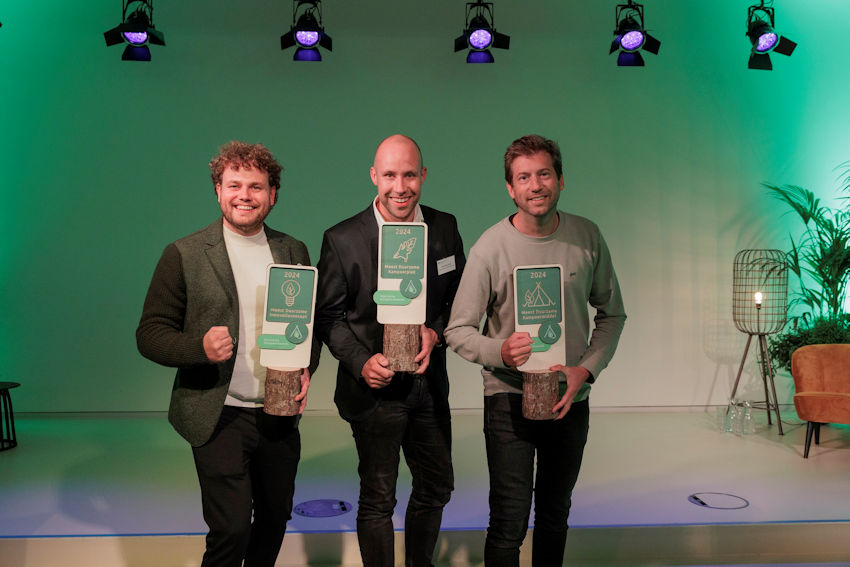
At the end of the evening, a few green pioneers were put in the spotlight with the presentation of the Sustainable Camping Awards. These were all (in addition to the winners, the nominees) entrepreneurs who want to make the world a little more sustainable.
- Most sustainable innovation concept: Hertzinger Green Connect
Jury report : “With their innovative combination of solar panels, batteries, heat pump technology, and smart software for energy sharing, Hertzinger Green Connect sets a new standard in the leisure sector. The concept offers a well-thought-out solution to grid congestion and makes stays energy-positive, more economically advantageous, and ecologically responsible.”
- Most sustainable camping equipment: eventje
Jury report : “eVentje continues to take impressive steps in sustainability and innovation. With an innovative design and the use of circular materials such as wood and sheep's wool, they underscore their commitment to a sustainable future.”
- Most sustainable camping spot: The Lemeler Esch
Jury report : “De Lemeler Esch has found a unique balance between nature, agriculture, and recreation. Their nature-inclusive business operations and innovative energy solutions make them a frontrunner serving as an example for other campsites.”
Sustainability conference camping sector
The Sustainability Congress for the Camping Industry is an annual event supported by the ANWB, HISWA Recron, NKC, KCI, Bovag and the Kampeer en Caravan Jaarbeurs.
More information: www.duurzaamheidscongres.nl/congres/terugblik/