The hotel guest pays more, but the hotel receives less. That is the paradox of the Dutch hotel market in 2026, according to ABN AMRO's sector analysis. While occupancy has recovered by historical standards, taxes constitute an increasingly large part of the bill, business demand is declining, and the scope for making a profit is shrinking. As a result, the battle is no longer solely about occupancy, but increasingly about return on investment.

Anyone looking solely at prices might think that hotels are riding the wave. According to Statistics Netherlands (CBS), consumer prices for hotel stays in the first eight months of the year were on average 11,1 percent higher than a year earlier. When the tax effect is removed from the same figures, the CBS states that an increase of only 1,8 percent remains. This effect is primarily the result of the increase in the VAT rate on overnight stays from 9 to 21 percent effective January 1, 2026. The guest therefore pays considerably more, but only a limited portion of that increase reaches the hotel.
In addition, hotels, like other businesses, are struggling with inflation. This would justify a price increase of approximately 3 percent in 2026, but only a minority of hotel owners manage to pass these costs on fully. Figures from hotel specialist Statler BI show that in the period from January 1 through April, only 19 percent of hotels had managed to fully incorporate both inflation and the VAT increase into room rates. By August, that share had risen to 26 percent. This suggests a move in the right direction, but after eight months, nearly three-quarters of the sector are still paying a portion of this increased burden out of their own margins.
For instance, in 2026 the price per room has risen further, while the hotel retains less per room sold. The Average Daily Rate (ADR) is the revenue per occupied room after deducting taxes and income from room service or minibars, among other things. Figure 1 makes it clear that the difference between the two is steadily widening. In 2018, a hotel guest in Amsterdam still paid approximately 20 euros in VAT and tourist tax. This year, that is well over 53 euros per night.
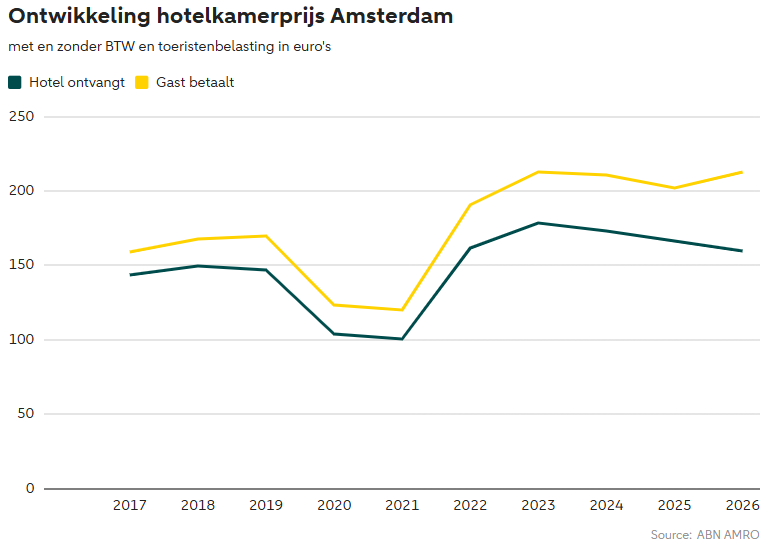
As a result, an increasingly large portion of the bill consists of taxes and does not reach operations. The guest sees a higher bill, and the hotel has less left to reinvest in staff, quality, and the level of amenities.
Staffing is not the problem
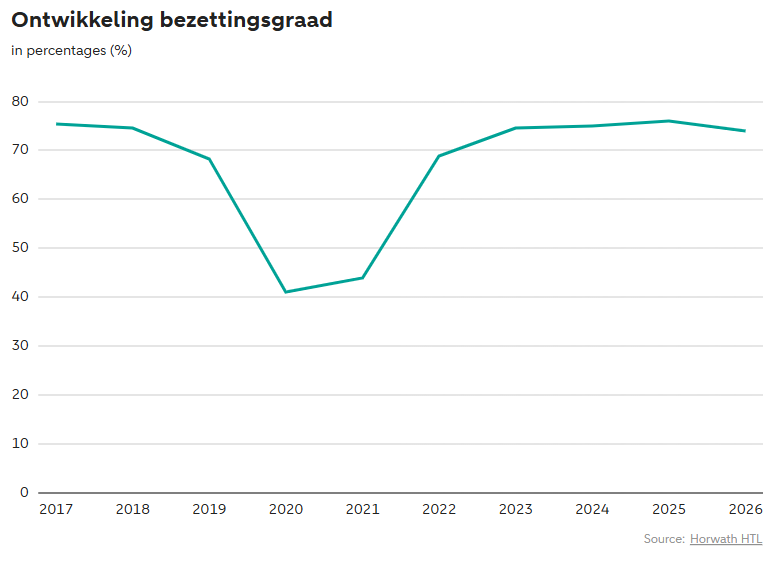
Hotel occupancy rates are relatively stable. However, looking only at the occupancy rate is insufficient. The relevant question is who books the rooms, when they are booked, and what the hotel earns from it.
The market is losing its highest-spending guest
According to Statistics Netherlands (CBS), Dutch hotels provided 30,8 million overnight stays in the first half of 2026, 1,8 percent fewer than a year earlier. Moreover, not a single month showed growth. However, behind this modest national average lies a much sharper shift. The number of business overnight stays fell by 9 percent during the same period, from 8,6 million to 7,8 million. This amounts to a loss of 780.000 overnight stays, while the total market lost 562.000 overnight stays. The decline in the business market thus explains almost entirely the decrease in the total number of hotel overnight stays.
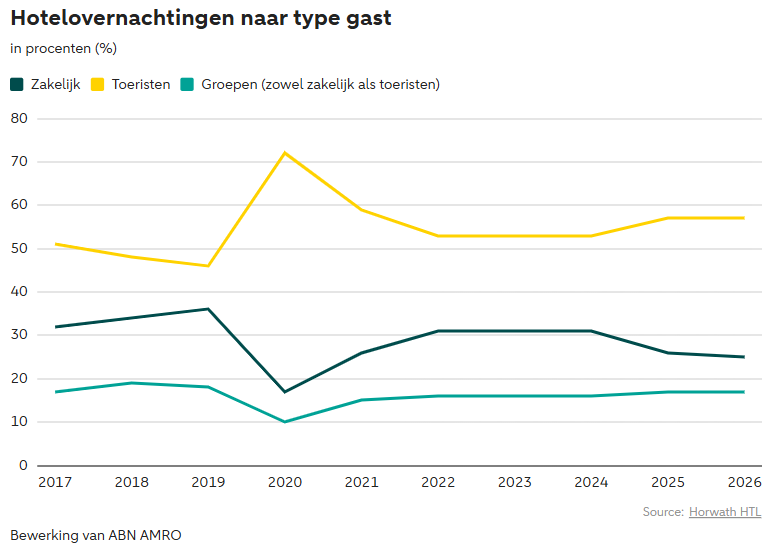
This development also appears to be structural in nature. In Amsterdam, the number of business overnight stays decreased from 5,82 million in 2019 to 3,59 million in 2025, a drop of over 38 percent. The share of business overnight stays fell from 31,7 to 16,7 percent during the same period. Nationally, the decrease amounted to approximately 20 percent. Amsterdam therefore lost a relatively large number of business guests.
The high tourist tax threatens to exacerbate this trend. Hotels are left with less financial leeway for investments in quality and amenities, while Amsterdam must compete with cities that levy no tourist tax or spare business travelers. ABN AMRO had previously warned of this risk. Current figures show that the business segment in Amsterdam has shrunk more sharply since then than in many other parts of the market. A targeted exemption for business stays or conference attendees, such as those implemented by many German municipalities, could mitigate this disadvantage.
Horwath HTL's detailed segmentation shows that individual tourists, in particular, have taken the place of business guests. This shift affects not only the number of overnight stays but also the economic value of demand. According to NBTC , a business guest spends more than twice as much as a leisure guest during a stay.
The decline in business demand directly impacts operations. Business guests often book on weekdays and outside of holiday periods. As a result, their decrease makes demand less evenly distributed across the week and the year. This makes it more difficult to align staff, prices, and other costs with expected occupancy.
Where the difference is really made
Occupancy rate and average room rate are the classic measures of hotel success. They determine how much revenue a hotel generates. However, when comparing hotel companies, one sees that enterprises with virtually the same occupancy and comparable room rates often achieve vastly different results.
Two hotels can both achieve an occupancy rate of 75 percent and charge the same average room rate, yet one hotel can achieve an EBITDA margin of more than 25 percent, while the other remains stuck at 10 percent. The explanation lies in the way revenue is converted into profit.
High revenue means little when departments contribute insufficiently to the operating result. The Uniform System of Accounts for the Lodging Industry (USALI) helps to categorize revenues and costs per department in a standardized manner. This reveals where revenue is leaking, which departments truly add value, and where intervention would have the greatest impact.
The biggest differences between hotels can usually be traced back to two factors: staff productivity and fixed costs. Staff productivity is the most important of these. This applies particularly to hotel restaurants. According to ABN AMRO, the lower limit for food and beverages is 60 euros in revenue per hour worked. Below that level, a department often no longer earns back its own personnel costs. Attracting more guests is by no means always the solution. In practice, adjusting opening hours, simplifying the menu, or limiting labor-intensive concepts often yields better results than chasing extra revenue.
In addition, fixed costs play a major role. Rental costs, in particular, do not always fluctuate with occupancy and therefore directly impact the result. As a rule of thumb, rental costs should be around 15 percent of turnover. Above 20 percent is a clear red flag, as operations then become heavily dependent on persistently high occupancy rates and room rates.
Make fixed costs less fixed
A hotel becomes vulnerable when revenue fluctuates but costs barely decrease. Resilient hotels therefore try to make their cost base as flexible as possible: scaling up when busy, scaling down when things go wrong. This does not mean cutting back on hospitality, but organizing operations in such a way that quality is maintained when occupancy and rates fluctuate.
Take the reception: not a counter that needs to be staffed eight hours a day, but guest support that is available when the guest needs it.
Or housekeeping. Room cleaning costs an average of about 7,5 percent of room revenue; above 10 percent, adjustments are necessary. By managing cleaning hours per room, distinguishing between intermediate and changeover cleaning, length of stay, and peak load, costs become manageable. Longer stays also help, as intermediate cleaning requires less work than a full changeover.
According to software company Mews , approximately 31 percent of hotel bookings in Europe are cancelled. Almost one in three reservations is therefore lost after all. Clear cancellation policies and deposits can limit this uncertainty. According to Mews, direct bookings with the hotel—without a booking platform as an intermediary—arrive on average 23 days earlier. As a result, the hotel gains insight into expected occupancy sooner and can better align staff and operations with demand.
According to Statler BI, some hotels spend only 1 percent of their revenue on their own marketing. That is low for a consumer sector and stands in stark contrast to Booking.com, which spends roughly five times as much on marketing the same room. It is therefore wise to invest more in marketing, targeting audiences that are growing and fit the location and concept of the hotel, such as sports enthusiasts or female solo travelers.
In addition, the returning guest is becoming increasingly important. Reward loyal guests with something extra and give them the option to pass that reward on to a friend. This way, a satisfied guest becomes not only a returning guest but also an ambassador for the hotel.
The paradox thus remains stark: the guest pays more, but the hotel does not automatically make more profit. In a market where taxes, costs, and changing demand patterns put pressure on margins, it ultimately comes down to the quality of revenue. It is not what comes in, but what remains, that determines a hotel's resilience. Hotels that actively manage net revenue, cost control, productivity, and guest mix create the financial headroom to continue investing in people, quality, and a sustainable future.
More information: www.abnamro.nl/zakelijk