People today are no longer just looking for experiences. People are looking for experiences where they can not only have fun, but also transform themselves. In the travel and recreation industry we must respond to this, otherwise we will be left out. That starts with the marketing strategy. This article gives you guidance on how to do this and discusses good practice examples.

The economy we live in now is about transformation – it is the time of “The New You Business”². Fashion brands turn you into the cool influencer you saw on Instagram. Dinner box suppliers turn us all into star chefs. Apps make us relaxed and give us time. Gyms ensure that we are all in shape. Soda salespeople make us become superheroes. It's about becoming the best version of ourselves. Brands give us that opportunity.
The Transformation Economy within travel & leisure
Your guest, traveler or visitor also changes. Free time is not just about being entertained. Free time is there to become a better version of yourself. It's the time to read a book, be the family man, discover yourself, learn to surf, come home with great stories. And preferably, completely tailored to yourself. So more egocentric.
We are now familiar with that experience of 17 different slides at a resort. The trend to go on holiday back to nature and explore the outdoors was already there pre-COVID, but COVID-19 has certainly accelerated this. This combined with the transformation economy creates demand for a new type of leisure activities.
This is of course a coincidence, because we all know that there are several leisure profiles³. The Transformation Economy is mainly a description that we all want to become the best version of ourselves in some way, with certain standards for each holiday profile. Some people return to nature for this, others want a wellness holiday according to the latest beauty standards. Another really wants to “be the fun parent”, reconnect and take those 17 cool slides with the kids. The continuous urge for transformation.
Examples within travel & leisure:
Concepts like Cabiner, which give you the power of nature
Concepts like Magic Kingdorm Park, that make you a princess
Concepts like Wellbeing Escapes, which promise you wisdom
Concepts like Adventure farm Molenwaard, who introduce you to farm life
Concepts like RØSTIG, which promise self-development through rest
Concepts like YOO HOTELS, which position self-development as a luxury
Strategic choices
The soul of a company is extremely important. This starts with Gen-Z, who demand that a brand or organization have a purpose. Brands are chosen because of who they are and how they contribute to someone's transformation, rather than what the experience is like.
What the Transformation Economy really needs:
Intensely personal approach
- Willingness from the brand or organization to meet needs
- A team that supports the values and approach
“In short, are you willing to change and join the Transformation Economy, or are you stuck in the now?”
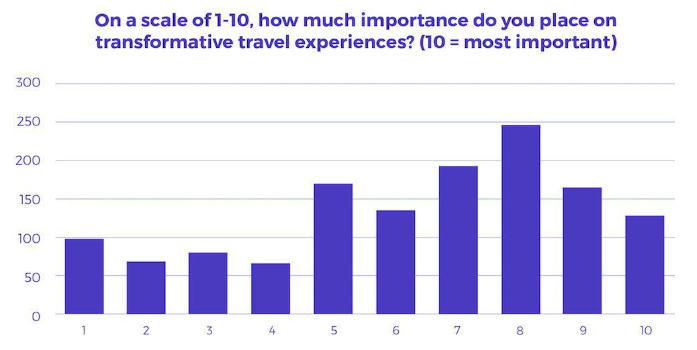
Consumers really find this important. Research by Skift (4) showed that in 2017 more than 54% of travelers (n=1.350) gave the importance of “transformational experiences” a 7 or higher.
An individualized approach for the masses
An individualistic (marketing) approach is what is extremely important within the Transformation Economy. Mass customization becomes the norm. In fact, there should be a personal approach in everything you do. This can also be if you receive a WhatsApp message before arriving at your hotel with the opening hours of the restaurant on site. And the question is whether you want to make a reservation immediately. Of course, such attention makes for a great experience. This will become the norm.
And that customization is not only in service – equipped with marketing automation. Also in the experience itself. Consider a curated workshop “Learning to make Italian pasta with a view of the Tuscan Hills” for someone who loves nature, gastronomy and local experiences.
How do you put the Transformation Economy into practice?
An inside-out approach is really necessary for this. It often starts with a fundamental strategic change in your own organization. Only from here can you start thinking about marketing content for your target groups.
Then it's time for outside-in. Evaluate your current marketing and business strategy and view it from the perspective of the market and your target group. Are you offering anything that will be appropriate in the coming years? How did you design the CX and does it still fit? Are your brand values still appropriate? Are your established marketing channels still the right ones?
It really takes time to develop and embrace this change. Take that time and exchange ideas with others inside and certainly outside your organization!
Source and more information: The Transformation Economy in travel