Artificial Intelligence (AI) is certainly not a hype. It impacts various business processes, including in the leisure sector. Applications exist in areas such as customer contact, support for dynamic pricing, marketing, and strategic decision-making. The first pilots at companies are showing promising results, but the relatively new technology also requires vigilance. The right mix of AI and human work remains crucial.
The first introduction; Chatbots
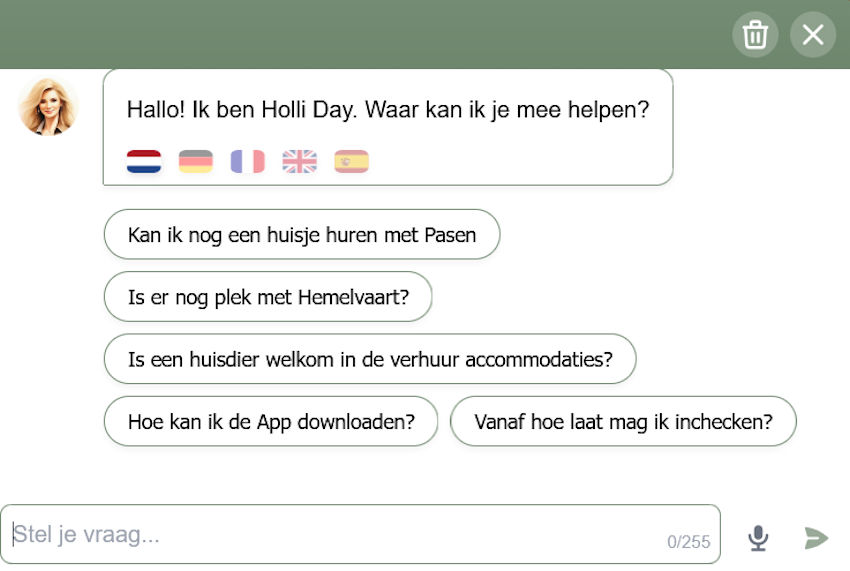
The first visible AI applications in the leisure and tourism sector were chatbots. These are deployed to somewhat relieve labor-intensive customer contact (telephone and email) and save costs. The teething problems of the first generation of chatbots still affect consumer acceptance; although the latest versions are particularly accurate and can often provide information faster than an average receptionist.
Chatbots capitalize on the touchpoints with the guest. The two main trends here are:
- The chatbot on the website that helps the consumer with the search and booking process. This is a tool that primarily supports marketing.
- In addition, there is a chatbot that helps guests at your park make their stay as pleasant as possible, for example with advice on excursions in the region or making a reservation for the restaurant. A commercial approach is promoting additional purchases (upselling).
Examples of this type of application:
- Chatbot Holli from Tenzer (www.holli.nl)
- Guestbutler Chatbot (www.guestbutler.ai, who makes good use of WhatsApp)
- Destination.ai – AI platform for Leisure & Tourism
The Evolution: From Chatbot to AI Agent
AI expert Chris van Vleuten (Destinatie.ai) is already looking ahead to future developments: “A massive shift is underway. A chatbot is a tool you ask a question to. An AI agent, on the other hand, is an autonomous 'employee'. You give an agent a goal, and it devises the steps itself and executes them within your systems without you having to intervene.”
AI in online marketing
The consequences of AI in online marketing are not a distant prospect; they are already clearly noticeable in the marketing tools of recreation companies. Roy Platje of Red Online Marketing observes that website traffic for many recreation businesses has dropped by as much as 20% in just one year. While findability in Google (SEO) has been essential in marketing in recent years, a second search option has been added at a rapid pace: being findable in search queries from AI agents. This is called GEO.
You absolutely cannot compare this to a new search engine. The way holidays are booked is changing structurally, and this has consequences for the way a reservation is made. We list some of the most far-reaching changes:
- Consumers using AI are taking control. Through smart AI Agents (often integrated into consumer apps), they can find their ideal vacation spot very specifically and at the lowest price.
- Consumer AI agents communicate with company AI agents. The company with the right offer must also communicate this (data). And because searches are becoming increasingly targeted, there is a need for (much) more details about your accommodation.
- Access to information is crucial for interaction between agents. However, that information does not necessarily have to be located on your company's own website. For the time being, that website remains a convenient interface if people want to look it up themselves. With the help of AI, however, you can effectively tailor the presentation on that website to the visitor.
AI to optimize business operations
AI will also help companies increase efficiency in daily operations and strategic decisions. Consider, for example:
- Pricing via dynamic pricing on the website. By automating this process, you can respond to changing market conditions much faster.
- Scheduling services; once a guest has checked out, AI can manage the cleaning. When checking out multiple guest groups, routing and restocking can be adjusted immediately.
- A holiday park generates data regarding guests and operations in various places. Through AI, data can be summarized and presented to management as a clear overview. (useful for operational and strategic management)
The next revolutions are already just around the corner.
The rapid rise of AI has already set in motion yet another new development, from which revolutionary changes are once again expected. If the trend of AI and robotization are combined, AI applications will be able to not only take over thinking work but also perform physical activities – largely independently. But that is worth an entirely new article.
Getting started with AI? Pay particular attention to:
- The correct phrasing of the question or command you give to the AI is crucial. And formulating those questions remains (for now) a human task. You can train yourself in this, and through experience, you develop a learning curve.
- AI also makes mistakes. Therefore, always check the results – especially in the initial phase of a new development. But AI can also learn; by correcting errors (manually), you make the AI application increasingly smarter and thus more reliable.
- Ensure that you protect your company's market-sensitive data from unauthorized access. Knowledge is power. AIs from (booking) platforms and competitors can gain a competitive edge through knowledge of your company and your guests.
- AI is already being widely used to gain consumer preference in the highly competitive market. You can also use AI to get to know your guests better and optimize customer relationships. In doing so, you (partially) sideline your competitors.
P.S. This article was not generated with AI and also appeared in the trade journal Recreatief Totaal.