The hospitality industry is a vital sector, but is structurally struggling with staff shortages. The pressure on the sector is high, partly because it relies on young people with a part-time job. At the same time, the number of MBO and HBO students in hospitality training courses is decreasing, which weakens the basis for sustainable staff growth. Possible solutions include better use of MBO students, the use of technology, and bringing in more lateral entrants.

The number of employees in the hospitality industry has been under pressure for a long time. The sector has had to deal with a high outflow of staff due to the closures during the corona pandemic. The sector has since recovered well from this shock, and the percentages of vacancies created and filled are back to their old level. However, it appears that the number of vacancies, namely 30.400 in the first quarter of 2025, is still high, but lower than the peak of 2022 and 2023.
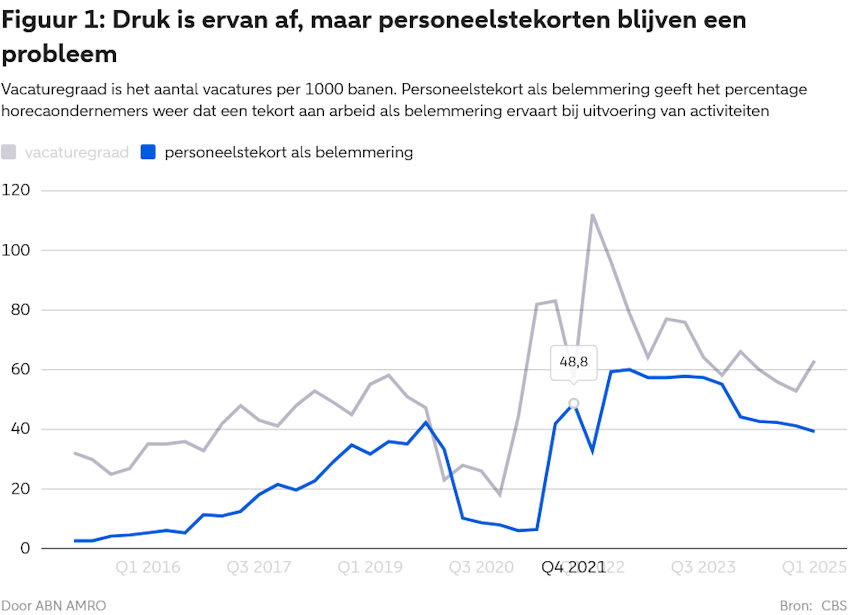
The vacancy rate of 63, the number of vacancies per 1.000 jobs, also shows that the pressure is decreasing, but not over (see Figure 1). The economic survey of Statistics Netherlands (CBS) of April 2025 shows that almost 40 percent of hospitality entrepreneurs still experience obstacles in the area of personnel. For example, almost 20 percent of restaurants and cafés limit their supply to the amount of labor that is available; for example, they are forced to close more often or earlier. Within the accommodation sector, which includes hotels and holiday parks, this concerns 12 percent of companies.
But hospitality entrepreneurs have not been sitting still. The aforementioned CBS survey also shows that more than a third of hospitality entrepreneurs are focusing on more attractive employment conditions, such as a higher salary, to attract staff. In addition, relatively many accommodation providers are focusing on automation to counter the shortage of staff; 25 percent of accommodation providers compared to 10 percent of restaurant and café owners.
Looking for a sustainable workforce
Young people are finding the hospitality industry as an employer again. Of the total workforce, around 58 percent are 15 to 25 year olds, compared to 2015 percent in 50 (see Figure 2).
It is essential to distinguish between two types of young people who work in the hospitality industry. On the one hand, the part-time workers who temporarily strengthen the sector during their secondary school or studies and leave after obtaining their diploma, and on the other hand, the MBO and HBO students who have chosen a study and career focused on the hospitality industry. While part-time workers are indispensable for flexibility and for absorbing peak pressure, the trained professionals ensure continuity and quality within the sector. It is important for hospitality entrepreneurs to retain this second group.
It is therefore a worrying development that the share of the 25 to 35 age group has fallen from almost 19 percent in 2015 to 12 percent in 2024 (see figure 2). The share of this group in the entire business community has been around 20 percent in the past ten years. In many cases, young people in the 15-25 age group apparently lack the prospect of continuing to work and making a career in the hospitality industry after their education. The fact that the flow of young people is stagnating is also evident from the fact that the average outflow age in the hospitality industry is only 25,1 years.
Of the total workforce within the hospitality industry, a quarter has obtained an MBO education at level 2 to 4, compared to 34 percent of the total labor market. The share of HBO and university graduates within the hospitality industry is also considerably lower than the national average: 11 percent compared to 36 percent.
At the same time, the number of hospitality and catering students at MBO and HBO levels is declining significantly. From 2020 to 2024, this number fell by 15 percent, and government forecasts predict a further decline in these figures. The Hospitality Pact is a great initiative to make hospitality education more attractive. It is a collaboration between companies, educational and knowledge institutions, and the government, and outlines how the sector can achieve a healthy labor market. One of the key priorities is ensuring a sufficient influx of qualified and yet-to-be-qualified talent into the labor market and educational programs.
Below we will first discuss the two groups of young people in more detail and then the use of technology and lateral entrants.
Part-time workers: flexible contracts and high outflow
The share of young people in the workforce is therefore large and goes hand in hand with a large share of flexible employment relationships in the hospitality industry (over 63 percent). For example, the sector has a large group of on-call workers (44 percent). Many employees need this flexibility, according to the National Survey of Working Conditions (NEA) of 2024; no less than 35 percent of employees in the hospitality industry indicate that they like flexibility. A third consider flexible employment relationships in the hospitality industry to be normal. Both percentages are significantly higher than the total of all sectors (20,8 and 20,7 respectively). The need for flexibility is particularly important among service workers (almost 41 percent), and slightly less so among cooks and kitchen assistants (almost 32 percent).
The outflow in the hospitality sector has also traditionally been relatively high due to the large proportion of young people. The outflow amounts to approximately 35 percent of the total number of jobs in the sector per quarter (see figure 4). Only the Rental and other business services sector has a higher share of outflow at 40 percent, according to CBS data. The National Survey of Working Conditions 2024 shows that hospitality employees work for their current employer for an average of 3,93 years; this number is the lowest of all sectors and substantially lower than the average of 8,73 for the entire business community.
Read the complete analysis at: www.abnamro.nl