Tourism is responsible for approximately 7% of total CO2 emissions worldwide, with the hotel industry also making up a significant share, in addition to aviation. An ING Research survey shows that sustainability is not a top priority for many hotel chains in the Netherlands. Guest comfort still trumps climate ambitions. After an initial wave of accessible energy-saving measures, further sustainability efforts in the sector have stalled.
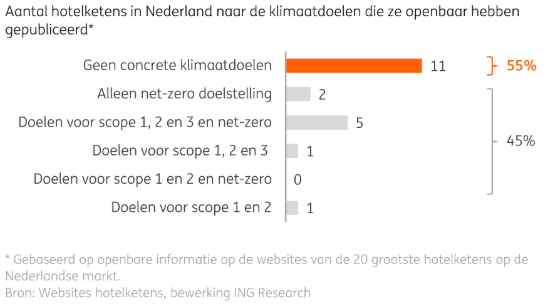
Several hotels are pausing their investments due to economic uncertainty and the impending VAT increase. Consumers are also not cooperating: ING's Question of the Day shows that sustainability plays little to no role in a majority of hotel guests' hotel choices. Nevertheless, further sustainability efforts are essential to future-proof the sector. This requires clear and consistent government policy and more active demand for more sustainable solutions from hotel guests and other partners.
Concrete climate ambitions are lacking
An ING Research survey of the twenty largest hotel chains operating in the Dutch market shows that more than half have not publicly published concrete climate goals. Some hotel chains have no more than a general CSR statement on their websites. Moreover, many sustainability reports from hotel chains, including those of some large international chains, are very brief.
Hospitality industry cautious about investing in sustainability this year
After catching up on energy-saving investments in recent years, Dutch hospitality businesses, including hotels, restaurants, and holiday parks, are marking time this year. This is because the most accessible investments in water and energy conservation, such as water-saving shower heads and LED lighting, have already been implemented. Further sustainability efforts require substantial investments, which many hotels and hotel chains are postponing, partly due to economic and geopolitical uncertainty. Furthermore, several hoteliers indicate they are marking time on sustainable investments due to the uncertainty surrounding the planned VAT increase in 2026.
It is necessary to encourage more sustainable behavior among hotel guests
Besides energy and water savings, reducing waste, combating food waste, and encouraging more sustainable behavior among hotel guests are also crucial factors in further reducing CO2 emissions. In theory, changing hotel guests' behavior is a relatively inexpensive solution that can yield significant CO2 savings. Cleaning hotel rooms less frequently and not changing towels daily can save water and energy consumption. Hotels are therefore increasingly focusing on this, although the prevailing belief within the sector is that this should not come at the expense of comfort.
Sustainability plays little to no role in hotel choice
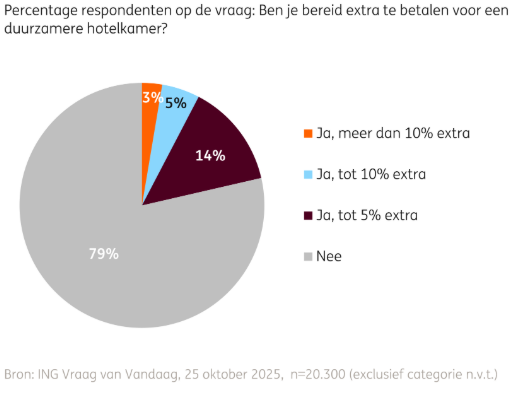
How sustainable is the behavior of hotel guests? Sustainability is often not a significant factor in hotel choices for a majority (77%) of hotel guests, according to the ING Question of the Day. Strikingly, this also applies to a majority of twenty-somethings, or the so-called Gen Z generation, who are often considered the most sustainable generation. Despite growing awareness of sustainability, price remains the decisive factor in hotel choices for most guests. Nearly 80% of hotel guests are unwilling to pay extra for a more sustainable room. Around 20% are, primarily guests aged 60 and older.
Current financial rewards appear ineffective
Small financial incentives, such as a discount or a free drink, appear ineffective in encouraging hotel guests to adopt more sustainable behavior. The ING Question of the Day report shows that only one in ten hotel guests is willing to skip daily housekeeping if offered a small reward. The willingness to skip the daily towel change is even lower: only 5% of guests agree to this in exchange for a free drink. Introducing a surcharge for daily housekeeping, for example, has a greater impact. A majority of hotel guests will forgo it if it involves additional costs.
Transition to a sustainable sector
"While many hotels have already taken steps towards sustainability, further sustainability efforts are needed to future-proof the sector," says Sjuk Akkerman, Sector Banker for Leisure and Services at ING. "The government can play a key role in this by providing a reliable framework and financial incentives. At the same time, hotel guests and other stakeholders, such as tour operators and booking platforms, must be encouraged to make more conscious and sustainable choices. This creates room for a profitable business case for sustainability. With consistent regulations, reliable data, and smart business models, the transition to a more sustainable sector can be accelerated. This requires effective collaboration between the government, the sector, and hotel guests."
More information: www.ing.nl/zakelijk