AI (Artificial Intelligence) is everywhere these days. It has become a huge umbrella term, sometimes causing confusion regarding the fine line and the overlap with traditional automation. Within online marketing, Booking Boosters combines these technologies to make marketing efforts more efficient, improve performance, and save time.
What is AI?
In the past, the term AI encompassed a wide range of things, such as machine learning and deep learning. However, the current hype revolves primarily around Generative AI and Large Language Models (LLMs), such as Chat-GPT, Claude, and Gemini. In simple terms, these AI models understand context and generate new content (such as text, images, or data analyses) based on a command (prompt).
Within marketing communications, this is ideal for assisting with text optimization, summarizing lengthy analyses, or editing imagery. For instance, a distracting object in the background of a photo can be removed, or a cloudy day can be transformed into a sunny one. Although the creative possibilities with AI are endless, it is important to use it responsibly. Therefore, applicable rules and regulations are always taken into account when generating and modifying imagery.


What is automation?
Automation is also a broad concept, but at its core, it comes down to a digital assembly line. It is a system set up with hard rules: if this happens, then do that . It automatically executes a specific task as soon as a certain 'trigger' goes off.
Consider an automated message sent to the right marketer or campaign manager as soon as there are issues with advertising costs. Or a script that searches all pages of a website for a specific promotional sticker or text that needs to be removed after a holiday period. Additionally, automation can process large amounts of data to quickly generate visual insights. Automation does not think, but blindly follows the rules.
The biggest difference: rules versus context
The main difference lies in flexibility and 'thinking ability'. Automation does exactly what is programmed, without assessing the situation. Suppose an automation is set up to end every sentence with an exclamation mark (!). If a sentence already ends with an exclamation mark, the automation coldly adds another one.
AI, on the other hand, understands the context. With a good instruction, AI sees that an exclamation mark is already present and intelligently skips this sentence. Where automation excels in repetition and flawless precision, AI excels in understanding and flexibility.
The perfect match: AI and automation working together
The real magic happens when these two forces are combined. Automation can be used to do the preliminary work, after which AI takes over the thinking.
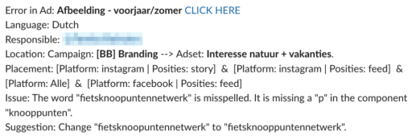
A concrete example is the automatic checking of hundreds of ads for spelling errors. The automation component automatically retrieves all active ad copy from Meta (Facebook and Instagram) or Google Ads and prepares it neatly. The copy is then forwarded to the AI. The AI reads the text, understands the grammar, and immediately identifies the spelling errors. Because marketers no longer lose valuable time on manual checks, there is more room for quality work. Time that can be directly invested in making content more unique and refining the campaign strategy.
When do you use what for your business?
As a rule of thumb: is a task repetitive, monotonous, and based on clear, fixed steps? Then it is perfect for automation. Imagine, for example, that a holiday park is fully booked for a holiday period. An automation immediately detects this in the booking system and sends a notification so that the running advertisements for that period can be paused. This prevents unnecessary advertising costs. That budget can then be immediately allocated to advertisements or campaigns that focus on periods that still require attention.

The next step: smart AI agents
AI is currently often still used in isolation to quickly type an email or look something up, but in combination with automation, it transforms into a strategic tool to work even more efficiently. Thanks to the rise of MCPs (Model Context Protocol), AI models can now 'communicate' directly with the software, databases, and systems (APIs) already running within an organization.
As a result, Booking Boosters is building advanced 'AI agents' that act as the ultimate assistant for marketers. Instead of a marketer having to manually sift through complex dashboards for hours to analyze data, they ask the AI assistant in natural language: “Which ads are currently underperforming and need attention?” The AI understands the question, activates the appropriate automation (the 'tool') to retrieve live data from Google or Meta, and lists the key bottlenecks and opportunities. This allows marketers to immediately get to work with the right data to make campaigns more unique, reach the target audience better, and improve performance. The AI agent therefore does the groundwork at lightning speed, so the marketer can pull the levers with maximum impact.

With thanks to (author of this article): Lars de Boer, Head of Marketing at Booking Boosters (part of Booking Experts)