For many Northern Europeans, summer means seeking out the sun in Southern Europe. But climate change is reversing this trend. Southern Europe is increasingly experiencing extreme weather: heatwaves, forest fires, downpours, and flooding. This is making more northerly countries, such as the Netherlands, increasingly attractive as summer holiday destinations.
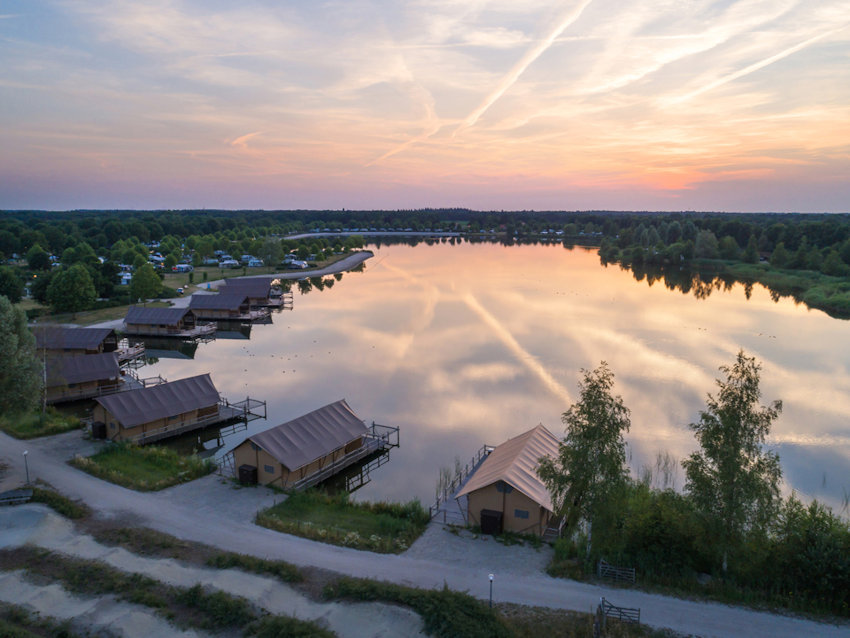
Amsterdam has long been popular with international tourists, but thanks to its excellent infrastructure and wide range of holiday parks, the Netherlands could further develop into an attractive summer destination for tourists from Southern Europe.
In this article, I (ed. Joost Gieling van Ginder) will explain to what extent climate plays a decisive role in choosing a holiday destination. I will then discuss the figures. Is the number of overnight stays in the Netherlands during the summer months by French, Italian, and Spanish tourists increasing, and what forecasts have recently been issued for further growth from these holiday destinations? I will conclude the article with advice for regions and businesses on how they can capitalize on the demand for tourist overnight stays from the Southern European target group.
Climate as a holiday choice; the rise of the Coolcation
The climate in Southern Europe is changing rapidly and becoming more extreme due to global warming. Heat waves are becoming longer and more intense, droughts are increasing, and the risk of forest fires and water shortages is rising. Heavy rain showers and hail are also becoming more frequent in mountainous areas such as the Alps and the Pyrenees.[1] The Netherlands is certainly not immune to the consequences of climate change: the summer season is becoming longer and sunnier, which is favorable for outdoor activities, but the weather is also becoming more erratic, with heavier rainfall and drier summers. Climate change is therefore having an impact everywhere, but in the Netherlands the consequences for holidaymakers appear to be milder for the time being.[2]
Climate change is playing an increasingly important role in the choice of a holiday destination. Travelers are increasingly taking into account the predictability of the weather, safety and their own health when making their plans.[3] Some articles now discuss coolcations, a holiday where people consciously choose cooler destinations to avoid extreme heat.[4] According to a survey by the European Travel Commission (ETC), 76% of European travellers have adjusted their summer plans because of the climate crisis, with over a third consciously avoiding destinations with extreme weather, especially in the Mediterranean.[5] Not without reason, countries such as Spain and Greece have taken measures to adapt to the changing circumstances.[6]
As a result of this climate change, the interest of summer holidaymakers is shifting to less traditional summer holiday destinations. Depending on how much the average temperature rises, models from the Joint Research Center show that demand for tourism in Southern Europe will decline in the summer, while Northern European regions will become more attractive.[7] The research shows that with an increase in average temperature of 3 or 4 degrees Celsius, the number of visitors to Southern Europe will fall by 10% in the summer months. In the more northerly coastal regions, on the other hand, the number of visitors will increase by 5%. Other research from Intrepid Travel shows that demand for holidays in Northern Europe has increased significantly in recent years due to the appeal of, among other things, the cooler climate.[8] These trends point to a fundamental reorientation of European travel behaviour under the influence of climate change.[9]
The Netherlands is increasingly becoming a destination for Southern European travelers
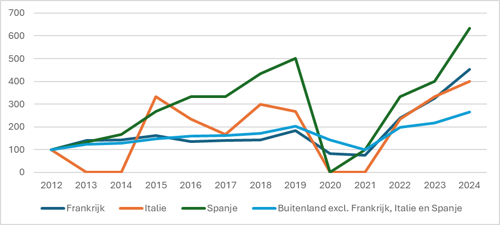
Statistics Netherlands (CBS) tracks the origin of tourist visitors to the Netherlands based on nationality. This allows them to investigate, among other things, the growth in the number of French, Italian, and Spanish tourists at Dutch holiday parks (no separate figures are available for other Southern European countries). This study examines the number of overnight stays during the summer months of July and August. Based on CBS figures, it is striking that the number of Spanish tourists in particular has increased sharply since 2012, by over 17% per year. This is considerably higher than the average growth in the number of overnight stays from abroad at Dutch holiday parks (approximately 8%). The number of overnight stays by French and Italian holidaymakers has also grown faster than this average during the summer months (13% and 12% respectively). In absolute numbers, there are still more French tourists than Italians and Spanish tourists at Dutch holiday parks. In recent years, in particular, there has been a strong increase in demand from Spain, Italy, and France. Since 2012, the share of the total number of foreign overnight stays at Dutch holiday parks during the summer months by French, Italian, and Spanish tourists has risen sharply from 1,3% in 2012 to 2,2% in 2024.
The Netherlands Board of Tourism and Conventions (NBTC) recently reported growth forecasts that provide insight into domestic and inbound residential tourism up to and including 2035.[10] Further growth in the number of foreign guests to the Netherlands is expected (annual growth of 2,8%), with the growth forecast from Southern European countries being well above this average. The NBTC indicates that Spaniards in particular have a growing preference for Northern European destinations with a milder climate. With these forecasts, it is also expected that the share of foreign overnight stays at Dutch holiday parks during the summer months by French, Italian and Spanish tourists will continue to increase.

Foreign investors smell opportunities
The impact of climate change on destination choices has not gone unnoticed by foreign investors. There is an increasing trend of French companies, such as Capfun, Huttopia, and Siblu, acquiring campsites in the Netherlands.[11] These acquisitions are leading to the transformation of traditional campsites into larger holiday parks, often featuring concepts they recognize from their own countries. They primarily target companies that already have a wide range of facilities. Recently, global asset manager Blackstone also entered the Dutch accommodation market by acquiring RCN Vakantieparken from its current shareholder.[12] Apparently, foreign investors see great potential in further growth of the Dutch accommodation market and are preparing for this by acquiring Dutch campsites.
What can governments and businesses do?
The increasing impact of climate change is changing the travel behavior of European tourists. Southern European destinations are becoming less attractive during the summer months. Conversely, Northern European countries, including the Netherlands, are gaining popularity due to their milder climate and excellent tourism infrastructure. In recent years, there has already been a strong increase in the number of Southern Europeans visiting Dutch holiday parks during the summer months, and forecasts indicate that this growth will continue. Foreign investors have also recognized this growth and are becoming increasingly active in the Dutch camping market.
It's important for governments to be aware that the Netherlands will become increasingly attractive as a summer holiday destination in the future. This leads to increased demand, both from foreign visitors and investors. A stronger role for (local) governments in managing this is necessary to ensure sustainable tourism growth. In recent years, recreation and tourism have become increasingly linked to societal challenges such as climate adaptation, health, area development, and livability, in both urban and rural areas. This is often seen as a connecting opportunity, and less often as a guiding principle in itself. This interconnectedness means that choices about recreation and tourism are no longer a sectoral issue, but part of broader spatial considerations. The rise of the Netherlands as a summer holiday destination underscores the need for government coordination to sustainably anchor tourism in the pursuit of broad prosperity.
There are opportunities for entrepreneurs to position the Netherlands as an alternative summer destination in collaboration with foreign tour operators. It's crucial to develop activities that appeal to Southern European tourists seeking to escape the heat and explore our country. Holiday parks can develop in a nature-inclusive way, thus contributing not only to climate goals but also offering an attractive (and cooler) environment for guests. The future of tourism may lie not in the sun, but in its shade.

With thanks to (author): Joost Gieling, recreation advisor at Ginder.
Joost: "Are you an entrepreneur who wants to learn more about the opportunities for your company? Or are you a government agency interested in developing appropriate policies? Then please contact us. We're happy to help."
Source and more information: www.wijzijnginder.nl
- [1] See among others: nos.nl, 'Southern Europe hit by heatwave, temperatures up to 45 degrees in Spain' (dd 28-6-25025) and rtl.nl, 'Huge amount of rain coming to the Alps: 'Could cause major problems'' (as of July 26, 7)
- [2] https://www.knmi.nl/over-het-knmi/nieuws/vakantieweer
- [3] European Travel Commission, Long-Haul Travel Barometer (2/2024)
- [4] https://www.dw.com/en/coolcation-is-climate-change-transforming-travel/a-70187090
- [5] European Travel Commission, https://transition-pathways.europa.eu/articles/sustainable-tourism-adapting-climate-induced-holiday-trends
- [6] https://www.travelandtourworld.be/news/article/northern-europe-becomes-the-new-summer-getaway-as-southern-europe-struggles-with-climate-change/
- [7] https://joint-research-centre.ec.europa.eu/jrc-news-and-updates/global-warming-reshuffle-europes-tourism-demand-particularly-coastal-areas-2023-07-28_en
- [8] https://www.intrepidtravel.com/nl/newsroom/releases/intrepid-expands-in-north-europe
- [9] European Travel Commission, https://transition-pathways.europa.eu/articles/sustainable-tourism-adapting-climate-induced-holiday-trends
- [10] NBTC, Forecast 2035. Expectation of residential tourism in the Netherlands (Feb. 2025)
- [11] Over there, “The major role played by French companies is striking” (Feb. 2022)
- [12] Fun work, Investor Blackstone becomes new owner of RCN Holiday Parks (June 2025)