The most important lesson Johanna Oosterbaan took away from a sometimes sharp debate during the National Tourism Summit: Diversity in the overnight recreation sector will not persist on its own. If revenue per square meter becomes the guiding principle, affordable camping and annual pitches risk disappearing. But who should steer this: the market, the entrepreneur, or the government? This report shows where interests clash and what leeway the sector needs.
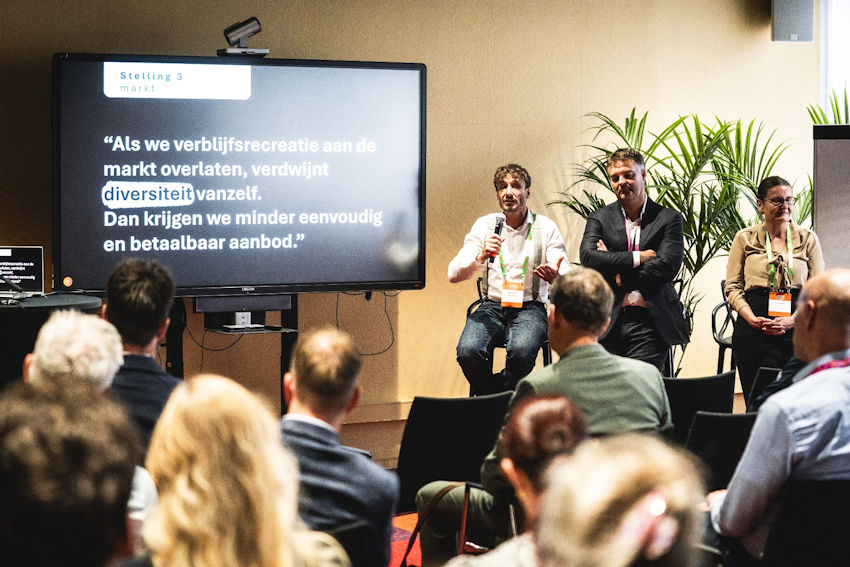
Strategy advisor Merlijn Pietersma chaired the panel. Joining the panel were Niels Leenders of Charme Camping De Rijnstrangen and board member of Vekabo In het Groen, Tim Slager, board member of MoleCaten and vice-chairman of HISWA-RECRON, and managing director Patricia Mulder of Siblu Villages Netherlands.
Entrepreneur or project developer?
Pietersma opened with a waterfront campsite, full of regular guests who view the place as their second home. A property developer wanted to build 30 luxury villas there, at 8 euros each. Is there a market for that? Probably. His question was sharper: Do we want that, at the expense of annual pitches, seasonal pitches, and camping spots?
Mulder clearly outlined the difference. A property developer develops, sells, and moves on to the next project. She wants to still see recreational businesses in twenty or thirty years. According to her, the public debate often focuses on real estate as an investment, with the recreation concept taking second place.
Slager pointed to parks where cottages have been sold individually to private individuals. Such a park will need to be renovated in thirty or forty years. Who will feel like an owner then? Leenders contrasted this with the horizon of the small entrepreneur. What will my place look like in twenty years? What do I contribute to the landscape and the village?
Prices up, margin the same
Do you have to earn more and more per square meter to remain future-proof? Leenders found that too narrow. His campsite has no swimming pool and no entertainment. The value lies in the landscape, personal hospitality, unique accommodations, and the story of the place. Can you live off that? “Yes, absolutely. It does require entrepreneurship, professionalism, and sensible investments.”
Slager remained level-headed. An entrepreneur must at least keep up with inflation; otherwise, according to him, it becomes a hobby. He calculated that, on average, about 44 cents of every euro now goes to charges and taxes. He consciously chooses a mix himself: rentals generate a return faster, while camping and annual pitches require less investment and take longer to pay for themselves.
Mulder was somewhat in between. The Netherlands is full, so endless expansion is not possible. At the same time, our country is becoming more attractive as a holiday destination now that summers are changing. According to her, innovation and sustainability allow you to get more value out of the same product. She also saw the limit with the guest: people are staying for shorter periods and there is a ceiling to what they are willing to pay.
A familiar voice came from the audience: “I raised my prices for two years and didn't earn a single cent more.”
Market or control?
Pietersma outlined a familiar trend. A meadow becomes a campsite, the campsite acquires glamping and chalets, and eventually a bungalow park stands there. Each step yields more per square meter. If you leave that to the market, according to the argument, diversity disappears of its own accord.
Opinions diverged here. Leenders argued for strategic government intervention. Mulder saw the market already correcting itself: returns on holiday homes are declining, yet people continue to go on vacation. According to her, there is always room for campsites that continue to innovate and listen to their guests. However, that supply must remain affordable. “Otherwise, people will just sit in their gardens.” Slager saw it differently; “What goes to a property developer doesn't come back on its own.” He compared it to the local supermarket: “Maybe it will return someday, but will there still be room then?”
What do you ask of the government, then? Above all, clarity. Mulder spoke about an expansion that the farmer, municipality, and village all support, and which has been in the procedure for seven years. For a smaller business, such a process is hardly affordable. Slager wants the government to designate land for recreational use, just as it does for agriculture and industry, and leave the implementation to the entrepreneur. He also saw recreation as part of the solution, for example, as a buffer between nature and residential areas. Leenders asked municipalities to think along with them, with fast procedures and rules that can be relied upon.
In the final round, Pietersma asked what they really need from the government: regulatory space, physical space, room in the business model, and clear, fast policy.
The voice of the entrepreneur
Much of the debate revolved around large parks, investors, and zoning plans. Precisely for this reason, it stood out that the small-scale entrepreneur in the green sector was prominently present at the table. Niels Leenders spoke partly on behalf of Vekabo / In het Groen, the association that advocates for small-scale accommodation recreation entrepreneurs.
He consistently raised the questions relevant to these entrepreneurs. How do you keep your place beautiful? What do you contribute to the landscape and the village? And as a small business, how do you get clarity from your municipality without years of procedures that only large parties can afford?
That is advocacy in practice. Ensuring that small-scale campsites are also taken into account when making decisions about space. Speaking with one voice, because an individual smaller entrepreneur rarely gets a seat at the table with the province or municipality.
My vision: affordable space for everyone
I owned a campsite myself for over nine years. Demand was high, and even though I raised prices every time to create more room in my margin, the guests kept coming. I see that happening with my clients now as well. I believe we need to keep affordable camping spots in nature. For the family with a tent, the couple with a caravan, the guest who isn't looking for a villa. The caravan market in the Netherlands is still growing. All those campers are looking for a spot.
That is why the small and medium-sized affordable campsite has struck gold: something no one can replicate. A spot in the landscape, space, and guests who return often. You can only hold onto that combination if you choose it yourself.
For me, that also includes stewardship. Whoever manages a piece of nature is responsible for what comes after them. You do this together with your guests, volunteers, and the government. In the session, Leenders showed what that looks like: an entrepreneur asking himself what he contributes to the landscape and the village. In this way, the campsite becomes a guardian of the space we share with each other.
Ready to see how Snowflake works?
In light of 'Value of Tomorrow', the theme of the Tourism Summit, innovation and contributions to the living environment remain necessary. There is room for various forms of overnight recreation. However, the figures must remain accurate, and appropriate spatial choices by government authorities are crucial.
With thanks to (author of this article): Johanna Oosterbaan
Johanna Oosterbaan ran a campsite for over nine years and is the founder of RecreatieBeleving. Together with her team and partners, she helped more than 300 recreation entrepreneurs with their marketing and business operations over a period of nearly ten years. Consequently, questions from this panel often come up: “ Where does the value of your own pitch lie, and how do you ensure that a higher price actually lands in the margin? ”
In the Recreation Growth Network, she translates her knowledge, experience, and insights into practical and concrete applications for individual businesses. Each month focuses on a different theme, such as findability, pricing strategy, working with AI, sustainability, review marketing, brand stories, and increasing bookings via their own website. Entrepreneurs bring their own challenges and receive assistance from 12 AI assistants, masterclasses, live Q&A sessions, and a forum with colleagues.
More information: www.recreatiebeleving.nl/groeinetwerk.