With the new interactive play concept Spark, Lappset moves interactive technology from a separate piece of play equipment to the playground as a whole. Light, sound, and sensors give children an initial impulse to move. In addition, careful thought has gone into 'collaboration' for this play concept: between children themselves and between children and their parents.

- The first Dutch location will be in the public space of the municipality of Waddinxveen.
- The first location is now operational in the home market of Finland.
- There is still a first to be awarded for the Dutch recreation sector.
From standalone device to complete play environment
Interactive elements are not new to the playground equipment market. Until now, however, interaction has largely been limited to a standalone piece of equipment with its own game or task. Spark opts for a broader approach. The technology is connected to traditional play structures, allowing different parts of the playground to together form a responsive play environment. This makes optimal use of the DNA of Yalp (which has since been fully integrated into Lappset) and Lappset itself, which is primarily known for playground equipment with extensive play possibilities.
Via wirelessly connected sensors, moving light, and dynamic sound, the environment reacts to what players do. For example, children receive spoken instructions, see lights change, or work towards a shared goal. No screen is needed for this. Climbing, running, balancing, and sliding remain the foundation. The technology does not fully dictate the game, but provides a starting point and leaves room for individual play styles.
“Spark builds on over twenty years of experience with interactive play and sports equipment, but takes the idea in a new direction,” says Product Manager Harrie Kerkhof of Lappset. “Instead of creating yet another separate interactive product, we are bringing connected technology into the traditional playground and allowing the broader play environment to respond.”
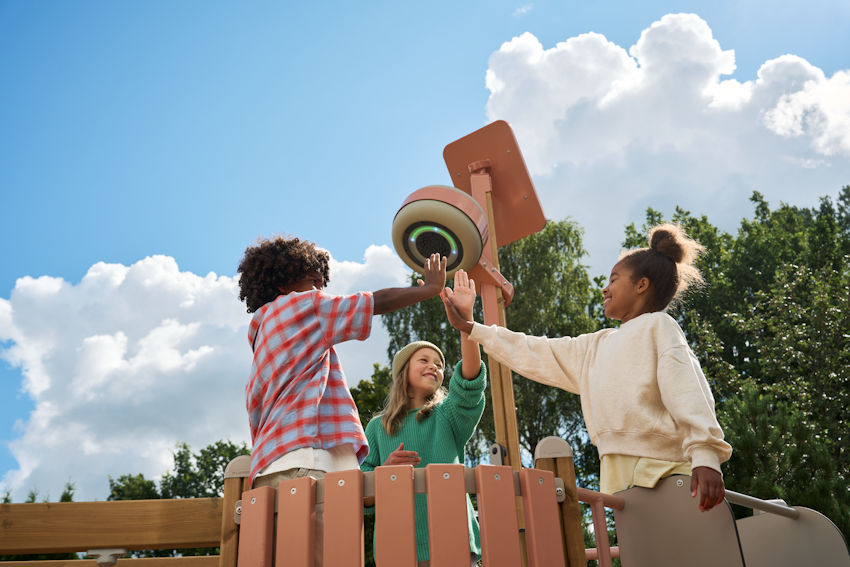
Playing together as a design principle
A second innovation is the emphasis on social interaction. Many digital or interactive games can be played by a single child. At Spark, however, tasks and game stimuli are specifically designed to draw players together. A shared challenge makes it easier to connect and start a game together.
This helps children who do not spontaneously come up with a game or join an unfamiliar group. A light signal, spoken challenge, or shared goal offers an accessible entry point. According to Kerkhof, Spark is therefore, at its core, not a technology product, but an invitation to play: the technology attracts attention, while movement and interaction drive the game.
Also designed for parent and child
The social aspect does not stop at children interacting with each other. The play components are sized so that adults can easily participate as well. With this, Lappset aims to encourage parent-child play. Parents do not have to merely watch from a bench, but can take part in an activity or take on a challenge together with their child.
This is relevant for operators and managers, as it makes the playground more explicitly a meeting place for the whole family. Moreover, the combination of shared physical activity and interactive play can offer an attractive outdoor play alternative to screen use indoors.
Modular offering and renewable game content
For recreation entrepreneurs, the flexible product structure is particularly relevant. Spark is available as a pre-assembled play set, as an integration into selected Lappset lines, and as custom work for larger theme projects. According to Lappset, the standard sets contain six games and ten so-called discoveries. The discoveries use light and sound for short play sessions without explanation; the games add instructions, challenges, and goals.
The games and challenges can be updated later and tailored to the design, layout, and theme of a location. This allows an operator to adapt the gaming experience without replacing the entire physical play area. For holiday parks, attractions, and hospitality venues, this offers opportunities to align the content with their own story or target audience and increase the repeat value of the play area.
Insight into usage without individual tracking
Spark records the total play activity in the environment. The system does not identify individual users, nor does it assess the performance of individual children. However, the collected non-personal usage data can provide administrators with insight into how intensively the play environment is being used. Because the system is connected online, they can refine settings and further develop the gaming experience based on actual usage.
In Waddinxveen, this measurement function is utilized for a Sparkathon: a week-long global gaming marathon during which total playtime and ranking are tracked online. Every new Spark location can launch such a challenge. For operators, this also serves as a public engagement surrounding an opening, holiday period, or event.
More information: www.lappset.nl/productlijnen/speeltoestellen/spark/