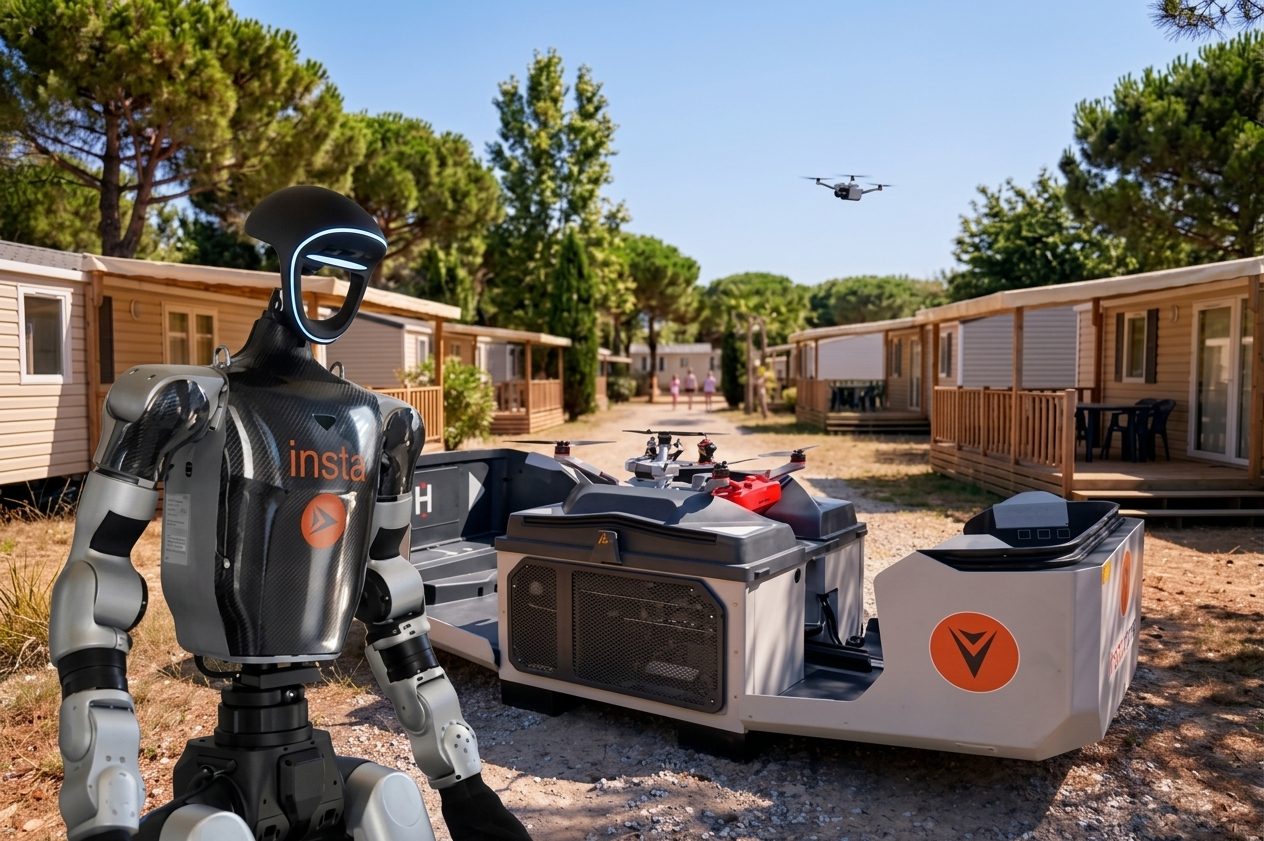
Autonomous drones for safety and emergency services, and humanoid robots that greet late-arriving campers in their own language. At the SETT trade fair in Montpellier, Instadrone is demonstrating how technology from other sectors is being translated into outdoor hospitality. Of particular interest to campsite owners is the step from demonstration to practical operation: which tasks can truly be automated, and when does this generate sufficient value?
SETT will take place in Montpellier from 3 to 5 November 2026. According to the organizers, the French trade fair features more than 730 exhibitors across approximately 60.000 square meters of exhibition space.
One of the most notable parts of the conference program comes from Instadrone. The company has been working with drones since 2014 for technical inspection, surveying, and surveillance, among other things, and is presenting applications for campsites and other tourist locations at SETT.
Drones for surveillance, fire detection, and emergency response
According to the press release, autonomous drones are being deployed for security and rescue operations, among other things.
The mentioned applications are nighttime drone flights to support beach surveillance, early detection of fire, and support for emergency services.
For campsites and holiday parks, the potential value lies primarily on large sites, along the coast, or in locations with nature and recreational water. A drone can survey a large area in a short time, but the business case depends heavily on scale, regulations, staffing, and which tasks can truly be performed without human supervision.
This does not automatically make the technology a replacement for security, surveillance, or emergency response. For the time being, its role as an additional tool that allows employees to receive information more quickly is more interesting.
Humanoid robot for late arrivals
In addition, Instadrone demonstrates a completely different application: humanoid robots for guest interaction.
The example from the press release is a camper arriving late. A robot can greet the visitor in their own language and then guide them to the correct campsite.
That touches upon a recognizable operational problem. Receptions are not staffed at full capacity, while arrivals during holiday periods can continue for a large part of the day.
The question is, however, whether a humanoid form is necessary for this. Many functions, such as digital check-in, route information, and multilingual communication, can also be handled via apps, kiosks, or smartphones. The added value of a physical robot will therefore primarily have to be demonstrated through guest experience, ease of use, and the ability to combine multiple tasks on location.
Technology must solve a concrete staffing problem.
For recreation entrepreneurs, the most interesting question is not whether robots and drones are technically impressive, but what problem they solve.
During staff shortages, applications can become interesting when they reduce repetitive tasks, support employees outside regular opening hours, or make information available more quickly.
This also involves new operational questions: who intervenes when the system fails, how is privacy handled, how does the technology integrate with existing reservation and security systems, and how much maintenance does the solution require?
It is precisely on those points that it will have to become clear whether applications from industry and security are also economically viable within a campsite operation.
SETT expands from camping to hospitality
The technological demonstrations align with SETT's broader direction. In 2026, the trade fair will introduce the name Sett Hospitality, thereby no longer focusing exclusively on campsites.
In addition to outdoor hospitality, hotels, the catering industry, guesthouses, and beach businesses are also explicitly mentioned as target groups. According to the organization, this broadening stems from the increasing convergence of recreational accommodation, hotel concepts, and the hospitality industry.
For Dutch recreation companies, this makes the trade fair interesting outside the traditional camping segment as well. Automation of reception, security, catering, and operational processes now plays a role in virtually all forms of hospitality.
Demonstration on November 4
Cédric Botella, CEO of Instadrone, presents the applications on Wednesday, November 4 at 2:30 PM during the session Drones and robots at the service of outdoor hospitality: rescue, prevention, and tomorrow's customer experience.
According to the organization, the presentation is being simultaneously translated into English.
More information
Source: SETT / Instadrone, press release October 2026. More information on the SETT and Instadrone websites . Image: Instadrone / SETT.