More than half of the Dutch population (52%) has experience using artificial intelligence when planning or booking a trip. This is according to consumer research by FBTO. We reviewed the insights from this report and asked AI marketing experts Red Online Marketing and Booking Boosters how best to capitalize on this.
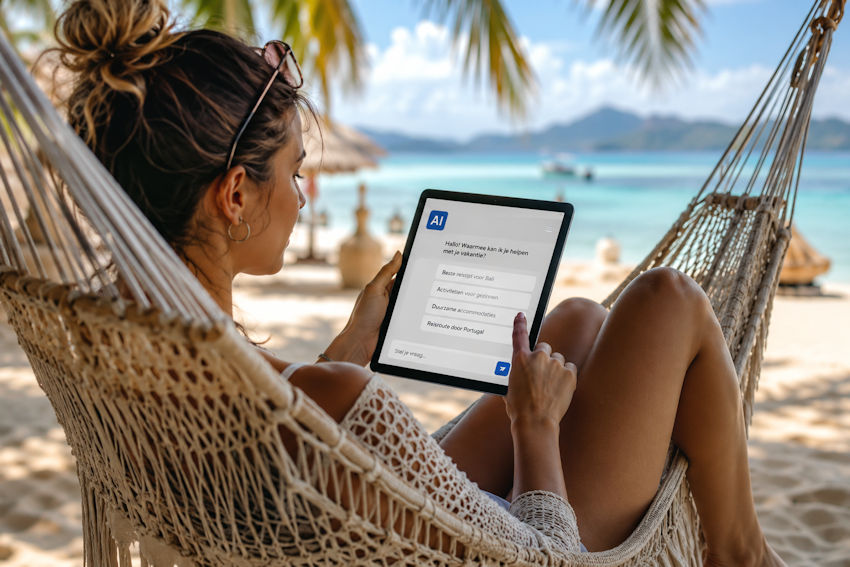
The digital travel buddy turns out to be far from always reliable: almost half of the users (46%) have been presented with incorrect information or tips.
AI as a travel assistant
Tips from family or friends, booking websites, travel agencies, review websites, and official websites such as the VVV are still the most frequently used methods for planning a trip or vacation. However, AI tools like ChatGPT, Claude, and Google Gemini have caught up. AI is frequently used for travel planning, particularly by travelers under 35 (76%). Furthermore, 40% of Dutch people who have not yet used AI expect to do so in the future.
Travelers primarily use AI to search for attractions (77%) or restaurants (68%) at their vacation destination. However, there are areas for improvement for AI tools: users are concerned that information might simply be incorrect (55%) and would like to see clearer source references in the AI output (38%).
Which AI tool gives the best travel tips?
FBTO tested the answers of AI tools to 80 travel questions for accuracy and completeness, among other things. One digital travel advisor proved to be significantly sharper than the others: Google Gemini scored best, followed by Mistral and ChatGPT.
Current events remain the biggest pitfall for AI tools. For instance, five out of six models were unaware that Bulgaria switched to the euro on January 1 of this year. Also, the Wilhelminatoren in Valkenburg was still recommended as a tourist attraction by five models, even though it collapsed in 2025.
More information: AI on Travel: which AI tool gives the best travel tips? | FBTO
Responding to the AI-driven holiday booker as a company
We asked two online marketing experts how you, as a recreation business, can respond to rapidly changing consumer behavior:
Rescue Online Marketing
We also see these trends among all our clients and throughout the travel and leisure industry. For many companies, this is a major problem, as they depend on attracting visitors at an early stage in order to subsequently, for example, remarket.
Roy Platje, director at Rescue Online Marketing
A structural adjustment of the strategy is therefore truly necessary. Especially during the orientation phase, visitors are visiting websites less and less, so organic traffic in that phase continues to decline. We also see that AI advice is being used increasingly often to put together more complex trips and tours.
We help our clients map this out and still be recommended by various AI tools. We do this by outlining the strategy and working with a custom-built monitoring tool that keeps track of the strategy and AI recommendations.
This way, we get a 360-degree view of the entire customer journey, from orientation to booking, and we can use this to help our customers.
Booking Boosters
The results of the FBTO study accurately reflect the shift that marketing agency Booking Boosters sees in the market. As travelers embrace AI en masse for the orientation phase, this presents both a huge opportunity and a challenge for leisure entrepreneurs.
“Since the arrival of AI search engines such as ChatGPT, Gemini, and Copilot, we have seen a significant increase in traffic from these sources to our clients,” says Booking Boosters. “Traditional searching via Google is not disappearing, but AI is increasingly functioning as the ultimate efficient digital assistant during the orientation phase. As a campsite or holiday park, you naturally want this assistant to recommend *your* location.”
How do you ensure that AI models select your park? Booking Boosters advises focusing on four strategic pillars:
1. Build online authority and mentionsAI models base their recommendations on reliable and relevant sources. Ensure that your holiday park is mentioned on external platforms, travel blogs, and by specialists within your specific niche. While traditional SEO relies heavily on link building, AI models take an even broader view: pure mentions, even without a direct link, are already immensely valuable. The more often your brand is mentioned positively on independent channels, the faster AI will consider your park an authority in the region.
2. Create unique content for the orientation phaseResearch what questions your potential guests have while making travel plans. Provide comprehensive and unique answers to these on your own website. If your content offers the best answers, AI will use this as a source.
3. Focus on brand awareness and positive sentimentAI models 'read' the internet to determine how a brand is being discussed. A strong stream of positive online reviews and consistent sentiment are therefore decisive. Ensure that your Unique Selling Points (USPs) are clearly highlighted everywhere, both on your own channels and on third-party platforms.
4. Optimize the website with structured dataAn indispensable technical step is intelligently structuring your website using so-called Schema markup or structured data. AI models love this clear, structured data. By assigning technical labels to your opening hours, facilities, prices, and locations, AI assistants can flawlessly understand your specific offerings and present them directly to the searching traveler.
Lars de Boer, Director Booking Boosters