Carnival celebrations remain one of the largest public events in the Netherlands. Figures from the National Visitor Index (NBI) show that visitor growth during Carnival 2026 will average +1,9% compared to 2025. This marks a clear leveling off after the strong +14% growth measured in the 2025 Carnival Index.
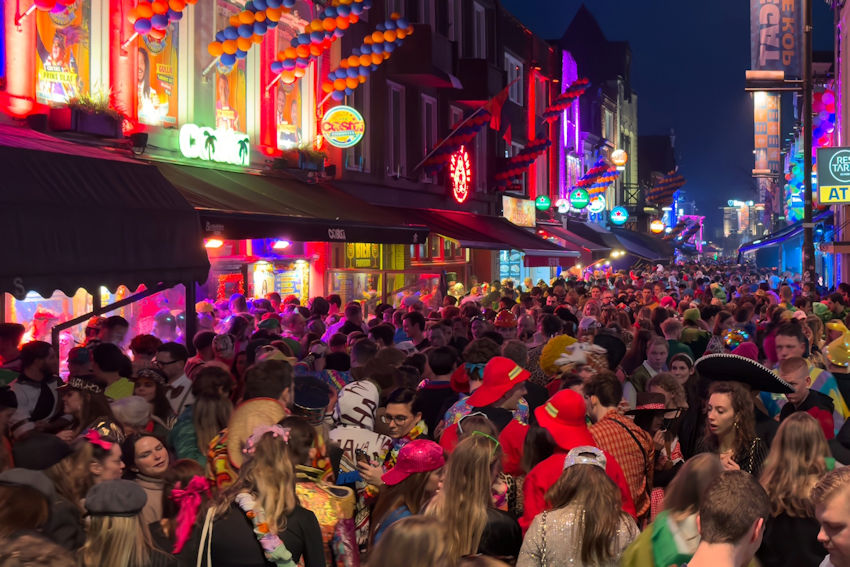
After a period of above-average growth, the trend in carnival visitor numbers appears to be stabilizing. The popular festival still draws large numbers of visitors to Dutch city centers, but the growth dynamics are visibly shifting.
Growth mainly visible outside traditional carnival areas
Weert will record the largest increase in visitor numbers during Carnival 2026, at +27%, after the city was among the biggest decliners in 2025. It's notable that other strong growth areas are also located outside the traditional Carnival regions. Nijmegen (+24%) and Oldenzaal (+15%) both showed significant increases.
This development points to a broader national distribution of visitor flows. Carnival is therefore not only manifesting itself in the traditional core areas, but also in cities outside of them, where visitor numbers are still growing strongly.
Growth and shrinkage within traditional carnival cities
A mixed picture emerges within the traditional carnival cities in 2026. Several large cities continue to grow, while others show a clear decline. Maastricht sees a 13% increase, followed by 's-Hertogenbosch (+6%) and Venlo (+4%). Although these growth rates are lower than in 2025, the figures confirm that these cities will maintain their position as major carnival destinations.
At the same time, other traditional carnival cities are seeing a decline. Geleen (-20%), Tilburg (-20%), and Bergen op Zoom (-22%) are registering a clear decline. Breda also recorded a decrease of -19% compared to 2025. This shows that the development within the traditional carnival regions is not uniform, but varies by city.
The leveling off or decline in some core cities aligns with administrative signals that have been visible in the media recently. Reports in newspapers like Algemeen Dagblad highlighted calls from cities like 's-Hertogenbosch to reduce Carnival's growth into a massive, festival-like event, emphasizing tradition, safety, and the manageability of the city center. While a direct causal link cannot be established, the figures suggest that visitor growth may be linked to administrative communication, public management, and thus changing visitor behavior.
Weather conditions influence visitor numbers
Besides policy factors, the weather also plays a role in carnival visitor numbers. In 2025, dry and sunny conditions resulted in high visitor numbers and distinct peak times. In 2026, the weather was more changeable, with cold and rain. This resulted in more spread-out crowds, and peak times were less concentrated.
From growth acceleration to stable diversification
Carnival 2026 doesn't mark a decline for the event, but rather a shift in dynamics. While 2025 was characterized by strong growth in visitor numbers, 2026 shows a more stable development with clear regional differences.
For city center managers, policymakers, and businesses, these figures underscore the importance of continuously monitoring visitor flows. Growth during Carnival is not a given and shifts between cities and regions. Data insights help municipalities better align policy, crowd management, and programming with actual visitor trends.
More information: www.nationalebezoekersindex.nl