The coalition plans to raise the VAT rate for overnight stays in hotels and accommodation providers from 9 to 21 percent starting in 2026. With this, the government hopes to generate additional tax revenue. Unfortunately, this measure does not appear to be well thought out. The consequences could be far-reaching for entrepreneurs both within and outside the hotel industry. As a result, those extra tax revenues could well turn out to be quite disappointing. This is evident from an analysis by economists at ABN AMRO.
According to the central government, a 12-percentage-point increase in VAT will lead to an expected tax revenue of 1,2 billion euros. For hotels and guesthouses, the VAT increase would result in 910 million euros in additional revenue, while 302 million euros could be collected from other accommodation providers.
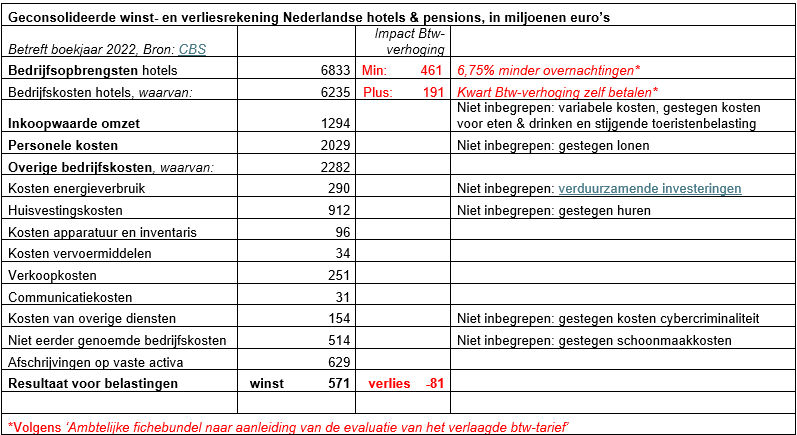
This is based, among other things, on the total operating revenues from actual business operations reported by Statistics Netherlands (CBS) , including sales of goods and services, inventory changes, and other income. Hotel operating revenues amounted to over 6,8 billion euros in 2022. This figure demonstrates the enormous economic contribution of the sector, which, however, is set to take a heavy hit from the VAT increase. The central government has also calculated that the number of overnight stays will fall by 6,75 percent if hotels absorb part (a quarter) of the VAT increase themselves.
Overestimation of tax revenues
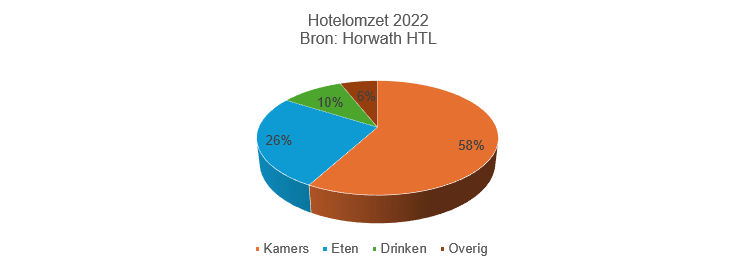
In addition to this damage to the recreation sector, the new cabinet may be overestimating the revenue it expects to generate. In its analysis, the central government incorrectly assumes that the VAT increase impacts the entire amount of 6,8 billion euros at hotels. However, nearly half of hotel guests (40 percent) are business travelers, for whom companies can reclaim the VAT. Furthermore, 36 percent of hotel revenue comes from the sale of food and beverages and 6 percent from ancillary services, such as the rental of meeting rooms, audiovisual equipment, bicycles, and parking spaces (source: Horwath HTL ). These are revenue categories that are not or hardly affected by the VAT increase. As a result, the VAT increase actually affects only 34,8 percent of total hotel revenue.
This much smaller scope of the VAT increase would result in only €285 million in additional VAT revenue from hotels. This amount is far below the expected revenue of €910 million.
Stef Driessen adds here when asked that the situation at holiday parks is slightly different: “At holiday parks, the ratio of business/tourist stays is different. For example, the income from food and drink is relatively lower. There are various other turnover categories, such as the rental of bicycles and sloops at many holiday parks.”
More setbacks expected
In addition, the government can expect more setbacks. According to Statistics Netherlands (CBS), Dutch hotels made a profit of 2022 million euros in 571 (see table). The hotels paid up to 25,8 percent (147 million euros) in corporate income tax on this. With the declining turnover and the additional costs due to the VAT increase, hotels are in danger of becoming loss-making and the income from corporate income tax will in principle fall to virtually zero. For the government, this means a blow of 147 million euros, while hotels have hardly any room left to invest in sustainability or improving employment conditions. And this while many hotels are still recovering from the major losses suffered during the corona pandemic.
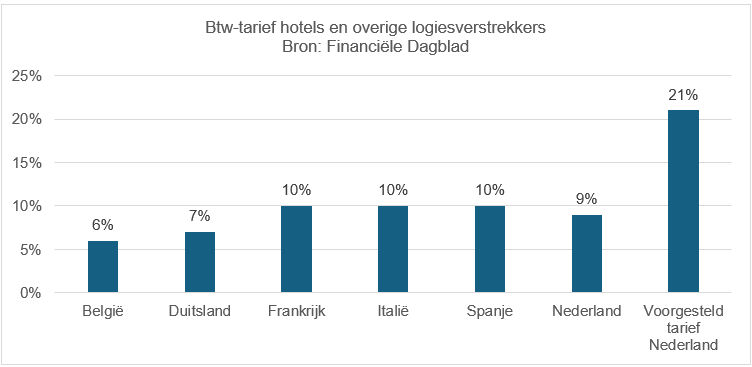
For other accommodation providers, the situation is particularly dire, especially in the border provinces. They are under significant pressure from competition from private home rentals and cheaper accommodations in countries such as Belgium, Germany, France, and Italy, where VAT rates are much lower. These offer a more attractive alternative for both domestic and foreign tourists, further increasing the pressure on Dutch accommodations. It is therefore obvious that other accommodation providers will also become less profitable due to the VAT increase. This loss of profit means a reduction in corporate income tax of a further 111 million euros, based on the result before tax reported by Statistics Netherlands (CBS) in 2022 and 25,8 percent profit tax.
Border provinces particularly affected
Municipalities and other government bodies are also losing revenue. This applies particularly to municipalities in the border provinces of Limburg, Gelderland, Drenthe, Overijssel, Brabant, and Zeeland, where a relatively large number of Dutch people spend their holidays. A decline in the number of overnight stays not only leads to lower tourist tax but could also mean a reduction in property tax in the longer term. This occurs when the value of hotel properties and other accommodation providers falls due to lower profits. It is likely that citizens will ultimately have to bear the burden of the resulting deficits.
In addition, suppliers, restaurants, cultural institutions, artisan shops, and public transport companies are directly feeling the impact of a decline in the number of domestic holidays. For instance, the most recent purchasing flow study in the eastern Netherlands found that dependence on tourism in the retail sector can rise to as much as nearly 10 percent.
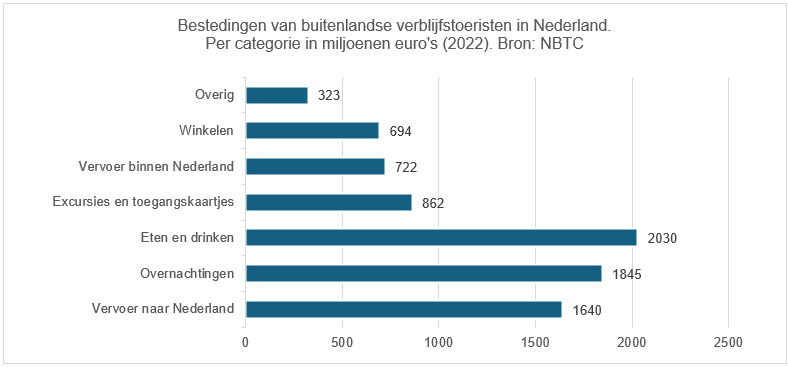
Foreign tourists staying in the Netherlands also spend only a quarter of their holiday budget on accommodation. The majority of their spending goes to local restaurants and businesses selling excursions and entrance tickets, or renting out bicycles and boats, for example. Fewer overnight stays mean less revenue for these businesses, which can amount to hundreds of millions of euros in lost turnover. This automatically leads to a decrease in revenue from VAT and corporate income tax for the government.
Source and more information: www.abnamro.nl