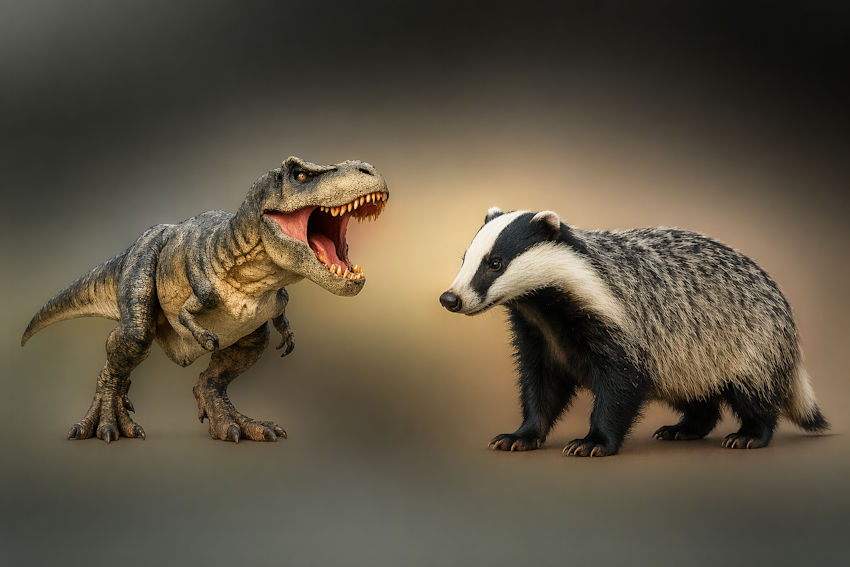
Libéma is currently investigating the possibilities for a new, innovative time travel park on the Autotron site, where an indoor exhibition, outdoor animal presentations, short-term recreational stays, and events come together. The plan, themed 'From Dino to Badger, ' aims to take visitors on a journey through time across the North Brabant landscape as it has developed from the Cambrian to the Holocene, featuring animal and plant species that have become extinct, but some of which still exist on Earth.
Libéma has initiated a feasibility study to determine which aspects of the concept plan are feasible. Part of this study also involves assessing the viability of potential ideas against (local) laws and regulations. The Municipality of 's-Hertogenbosch is facilitating this, and both parties have signed a preliminary agreement to this effect.
Wildlife Park Brabant
The aim is to use the park, provisionally named Wildlife Park Brabant, to tell the story of how the landscape of the province of North Brabant has developed from the Cambrian period (541–485 million years ago) through the Holocene (present).
This will take place partly in a large indoor space of 8.800 square meters and partly in an outdoor park, which also houses 150 holiday homes. Thanks to the planned covered exhibition, the park is suitable for all weather conditions. The current Autotron Exclusive, the tennis courts, and the existing events will remain. Libéma Director Dirk Lips: “Instead of expanding these activities, we want to explore whether it is possible to develop new activities alongside them.”
Dinosaurs and mammoths
An exhibition is planned in the 8.800m² indoor space featuring, among other things, life-sized moving dinosaurs, mammoths, cave bears, and saber-toothed tigers. Lips: “It is remarkable that life forms from 0,5 billion years ago are still present on our Earth. In this way, the story from the Cambrian through the Holocene can also be told using living organisms.”
Outdoors, Wildlife Park Brabant aims to showcase animals that once lived in these regions and are still present on Earth, such as rhinoceroses, hippopotamus, lions, and bison, as well as animals that currently occur in Brabant or could potentially occur there, such as lynxes, badgers, and aurochs. In the context of animal welfare, the development of the park will be coordinated with the European zoo organization EAZA.
Nature and landscape
Lips: “Nature and landscape are the starting point for the design of Wildlife Park Brabant. The design is integrated into the landscape and shaped in such a way that, in addition to enclosures for non-native animal species, space is also created for native species. This concerns both flora and fauna.”
By not only showcasing the animals currently living on Earth but also telling the story of the geological development of North Brabant and the Netherlands in an educational manner, and the flora and fauna as they have evolved there, Wildlife Park Brabant distinguishes itself from other zoos in terms of education as well. For the educational component, in addition to still-living animal and plant species, augmented reality, animatronics, and 3D film effects may also be used.
“With this, we have developed a unique concept that is not only new to the Netherlands, but to all of Europe. Research will have to show whether this is actually feasible, but we truly believe that this could be a great addition to 's-Hertogenbosch and the province of North Brabant,” says Lips.
Employment
Lips expects the new concept to generate 187 full-time positions. A portion of this employment will be filled by people facing barriers to employment. There is also room for older people who wish to work part-time.
Wildlife Park Brabant is planned on the grounds of the current Autotron and Hypeco site. The adjacent holiday park Dierenbos, also part of Libéma, is not included in these plans. Lips: “We also have great development plans for this, but they are completely separate from Wildlife Park Brabant.” 't Soperse Bos and Nachtegaal also fall outside these plans.
The feasibility study takes approximately a year. Only then will it be clear whether the plan can actually be implemented in its entirety, partially, or not at all.
Source and more information: www.libema.nl