Hospitality is a people-driven business – and due to an aging population, staffing challenges are expected. Unless, of course, you're also going to be using the 67+ group. In a webinar, employment agency Zilver Werkt explains the opportunities and requirements that come with working with people aged 67 and over.
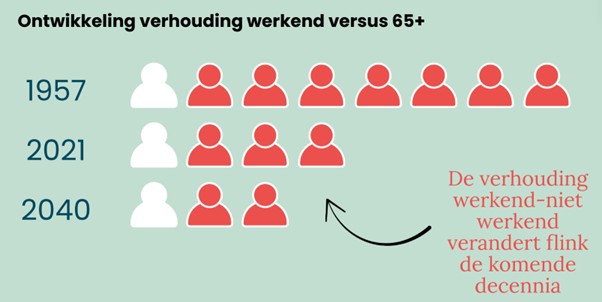
The webinar with Chantall Olthoff and Mark van der Stok (both from Zilver Werkt) begins with an overview of demographics – specifically the ratio between the working population and those past retirement age. These are developments beyond the control of the government and/or business owners. Society needs to take them into account. Labor-intensive sectors, in particular, will be affected.
A growing group of people aged 67 and over want to continue working
While retirement age used to be the final point for people to stop working, many now see "continuing to work after retirement" as an option. But at a somewhat lower intensity – and primarily with a work structure that provides satisfaction in life.
In 2025, 300.000 people aged 67 and older will be registered as working, with an average working week of 18 hours. Van der Stok: "We expect this number to grow to 1,5 million by 2040."
Prejudices hinder development
The growth in the number of people who continue to work seems like a logical solution to the labor shortage. However, employers still face significant challenges. There appear to be many prejudices against older workers (which often prove to be unfounded):
- Is a worker sick more often?
- They are less good at handling technology
- Older people are less flexible
- People are not willing to learn or retrain.
- Older staff are more expensive
In the webinar, these topics are tackled one by one. Mark mentions an important premise that employers often overlook: “Today’s 70-year-old is comparable to the 50-year-old of 30 years ago. Many people are still remarkably fit in their 70s and are often still full of ambition and desires.” Chantal also mentions her own 80-year-old father: “According to societal norms, he is very old, but in practice, he still works with great pleasure.”
It is also recognised that there are differences with regular employees, but this does not necessarily mean a limitation.
- For example, people who continue to work often have a different motivation to work – less focused on income and more on fulfilling their lives.
- Often, people who continue to work don't want to work full-time (anymore). This can be overcome by combining them.
Chantal also mentions some advantages that continuing workers have for a company:
- This way, you gain a wealth of knowledge and (life) experience. Many older employees within companies act as mentors to younger generations just starting out.
- The positive attitude of many hard workers – people work primarily for the pleasure of their work – also radiates to the entire work environment.
Watch the webinar here:
More information: www.zilverwerkt.nl