Last week, HISWA te Water was organized once again in Lelystad. Naturally, you could shop for a beautiful new vessel there. In addition, it is a networking opportunity for the watersports sector where various developments are discussed. For example, the rise of more sustainable boats and options for the (growing) rental sector.
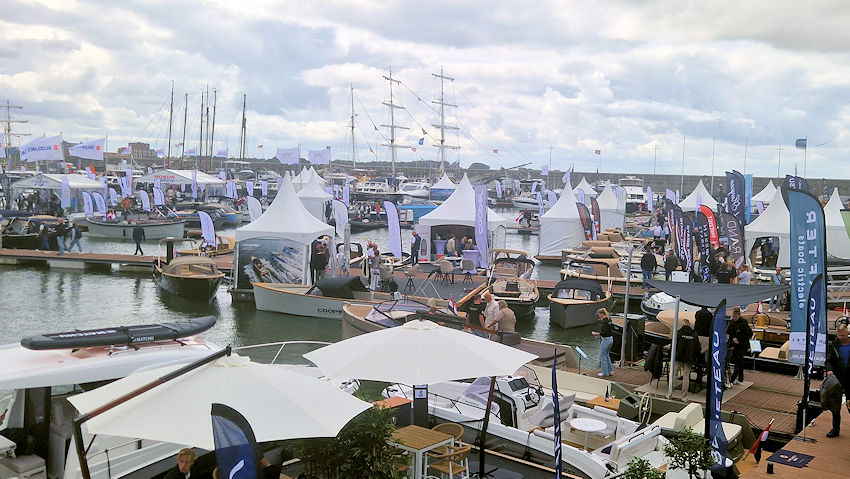
During our visit, we focused less on the boats and more on the underlying trends. These are also important for marinas and other providers of recreational facilities. At the Municipality of Lelystad stand, the link between water sports and inland entertainment was also explicitly emphasized.
The most important lesson from Hiswa te Water 2026 is perhaps that the future of boating tourism is not determined solely by the sale of new boats. Growth also lies in accessible use, new packages, more sustainable rental fleets, unique vessels, and attractive waterfront destinations.
Digitalization supports the customer journey
This year, Hiswa te Water introduced an AI application that allowed visitors to plan their route across the exhibition and locate exhibitors and boats specifically. On social media, exhibitors were not only presented in advance, but visitors also received practical information regarding the floor plan and the program.
This approach is also applicable to boating areas. Digital route planning can link visitors to moorings, hospitality venues, shops, attractions, and accommodation. For marinas and rental companies, online reservations and integrated management systems offer opportunities to better organize availability, payments, and guest communication.
Use more important than ownership
HISWA-RECRON notes that the trend of 'use instead of ownership' continues. Consumers do not need to own their own boat to take to the water. As a result, rentals, boating schools, sharing concepts, tours, and packages are becoming more important.
This development aligns with the 2024 Water Sports Survey. Almost a third of adult Dutch people participated in one or more forms of water sports that year. This involved approximately 4,6 million people. Slooping and stand-up paddleboarding (SUP) are among the most popular activities. According to the factsheet on the economic value of water sports, water sports enthusiasts collectively spend nearly €1 billion per year on water sports activities and day trips.
For holiday parks, campsites, and waterfront hospitality businesses, there is an opportunity here to easily link boating to the stay. This can be done through direct rental, but also by collaborating with a local marina, boating school, tour boat company, or sloop rental provider.
Marina as a destination
During the fair, the Bataviahaven functioned emphatically as a recreational destination. Boats, demonstrations, catering, terraces, shops, and activities were combined into a full-day program. The proximity of Batavialand and Batavia Stad also reinforces this purpose.
With this, the trade fair confirms a development that HISWA-RECRON has been observing for some time: marinas are no longer focusing exclusively on berth holders and transients, but also on visitors without their own boat. Hospitality, rentals, events, recreational routes, and accommodation concepts can give the marina a broader economic base.
From boat product to recreational application
The exhibition also showed that boat builders are increasingly designing based on specific usage situations. Among the exhibits on the new Aluminium Island was the Silverfloat Scout 35, a custom-made vessel that is wheelchair accessible and can run on both electricity and diesel. Elsewhere at the exhibition, an electrically powered and electrically heated floating hot tub was on display.
Those examples are not all directly intended for large-scale rental, but they do demonstrate the broadening of the market. A boat can be a means of transport, accommodation, a wellness product, an attraction, or part of a package. Houseboats were also present at the fair as a separate segment.
Electric propulsion continues to grow
We can no longer call the electrification of the fleet a 'trend'. Legislation and regulations are also driving the rapid realization of fossil-free water sports. It is striking that electric boating is no longer exclusively associated with slow-moving sloops. For instance, the Helios Omega 7.2 was featured in the daily news, an electric cruiser with a 50 kW motor and a stated top speed of 30 kilometers per hour.
For rental companies and recreational businesses, the growing variety is particularly relevant. Electric boats are becoming faster, have a greater range, and are becoming available in an increasing number of price ranges. A Corsiva 601 e-tender, for example, was presented as an electric family boat starting at just over €20.000. This makes electrification more accessible for rental fleets, but does not eliminate operational considerations such as charging capacity, grid connection, and sailing time.
More information: www.hiswatewater.nl/